Công Cụ và Thư Viện Giao Dịch
Mục lục bài viết

Công Cụ và Thư Viện Giao Dịch
Trong bài viết này, chúng ta sẽ tìm hiểu về các công cụ và thư viện phổ biến được sử dụng trong giao dịch tự động.

Phân Tích Dữ Liệu
1. Pandas
import pandas as pd
import numpy as np

# Đọc dữ liệu giá
df = pd.read_csv('price_data.csv', index_col='date', parse_dates=True)

# Tính toán các chỉ số kỹ thuật
def calculate_technical_indicators(df):
    # Moving Average
    df['SMA_20'] = df['close'].rolling(window=20).mean()
    df['EMA_20'] = df['close'].ewm(span=20).mean()

    # RSI
    delta = df['close'].diff()
    gain = (delta.where(delta > 0, 0)).rolling(window=14).mean()
    loss = (-delta.where(delta < 0, 0)).rolling(window=14).mean()
    rs = gain / loss
    df['RSI'] = 100 - (100 / (1 + rs))

    # MACD
    exp1 = df['close'].ewm(span=12, adjust=False).mean()
    exp2 = df['close'].ewm(span=26, adjust=False).mean()
    df['MACD'] = exp1 - exp2
    df['Signal'] = df['MACD'].ewm(span=9, adjust=False).mean()

    return df
2. NumPy và SciPy
import numpy as np
from scipy import stats
from scipy.optimize import minimize

# Tính toán các thống kê
def calculate_statistics(returns):
    mean_return = np.mean(returns)
    volatility = np.std(returns)
    sharpe_ratio = mean_return / volatility
    skewness = stats.skew(returns)
    kurtosis = stats.kurtosis(returns)

    return {
        'mean': mean_return,
        'volatility': volatility,
        'sharpe': sharpe_ratio,
        'skewness': skewness,
        'kurtosis': kurtosis
    }

# Tối ưu hóa danh mục đầu tư
def optimize_portfolio(returns, cov_matrix):
    n_assets = len(returns)

    def portfolio_stats(weights):
        portfolio_return = np.sum(returns * weights)
        portfolio_vol = np.sqrt(np.dot(weights.T, np.dot(cov_matrix, weights)))
        sharpe = portfolio_return / portfolio_vol
        return -sharpe

    constraints = ({'type': 'eq', 'fun': lambda x: np.sum(x) - 1})
    bounds = tuple((0, 1) for _ in range(n_assets))

    result = minimize(
        portfolio_stats,
        x0=np.array([1/n_assets] * n_assets),
        method='SLSQP',
        bounds=bounds,
        constraints=constraints
    )

    return result.x
Học Máy
1. TensorFlow
import tensorflow as tf
from tensorflow.keras import layers, models

# Xây dựng mô hình dự đoán giá
def build_price_prediction_model(input_shape):
    model = models.Sequential([
        layers.LSTM(64, input_shape=input_shape, return_sequences=True),
        layers.Dropout(0.2),
        layers.LSTM(32),
        layers.Dropout(0.2),
        layers.Dense(16, activation='relu'),
        layers.Dense(1)
    ])

    model.compile(
        optimizer='adam',
        loss='mse',
        metrics=['mae']
    )

    return model

# Huấn luyện mô hình
def train_model(model, X_train, y_train, X_val, y_val):
    history = model.fit(
        X_train, y_train,
        epochs=100,
        batch_size=32,
        validation_data=(X_val, y_val),
        callbacks=[
            tf.keras.callbacks.EarlyStopping(
                monitor='val_loss',
                patience=10
            )
        ]
    )
    return history
2. PyTorch
import torch
import torch.nn as nn

# Xây dựng mô hình phân loại tín hiệu
class SignalClassifier(nn.Module):
    def __init__(self, input_dim, hidden_dim, output_dim):
        super(SignalClassifier, self).__init__()
        self.lstm = nn.LSTM(
            input_dim,
            hidden_dim,
            num_layers=2,
            batch_first=True
        )
        self.fc = nn.Sequential(
            nn.Linear(hidden_dim, 32),
            nn.ReLU(),
            nn.Dropout(0.2),
            nn.Linear(32, output_dim)
        )

    def forward(self, x):
        lstm_out, _ = self.lstm(x)
        return self.fc(lstm_out[:, -1, :])

# Huấn luyện mô hình
def train_classifier(model, train_loader, criterion, optimizer):
    model.train()
    for batch_idx, (data, target) in enumerate(train_loader):
        optimizer.zero_grad()
        output = model(data)
        loss = criterion(output, target)
        loss.backward()
        optimizer.step()
Backtesting
1. Backtrader
import backtrader as bt

# Chiến lược giao dịch
class MovingAverageStrategy(bt.Strategy):
    params = (
        ('fast_period', 10),
        ('slow_period', 30),
    )

    def __init__(self):
        self.fast_ma = bt.indicators.SMA(
            self.data.close,
            period=self.params.fast_period
        )
        self.slow_ma = bt.indicators.SMA(
            self.data.close,
            period=self.params.slow_period
        )
        self.crossover = bt.indicators.CrossOver(
            self.fast_ma,
            self.slow_ma
        )

    def next(self):
        if not self.position:
            if self.crossover > 0:
                self.buy()
        else:
            if self.crossover < 0:
                self.sell()

# Chạy backtest
def run_backtest(data, strategy):
    cerebro = bt.Cerebro()
    cerebro.adddata(data)
    cerebro.addstrategy(strategy)
    cerebro.broker.setcash(100000.0)
    cerebro.broker.setcommission(commission=0.001)

    results = cerebro.run()
    return results
2. Zipline
from zipline.api import order, record, symbol
from zipline.finance import commission, slippage

# Chiến lược giao dịch
def initialize(context):
    context.asset = symbol('AAPL')
    context.sma_period = 20

    # Thiết lập commission và slippage
    context.set_commission(commission.PerShare(cost=0.001, min_trade_cost=1.0))
    context.set_slippage(slippage.VolumeShareSlippage(volume_limit=0.025, price_impact=0.1))

def handle_data(context, data):
    # Tính toán SMA
    sma = data.history(context.asset, 'price', context.sma_period, '1d').mean()
    current_price = data.current(context.asset, 'price')

    # Tạo tín hiệu giao dịch
    if current_price > sma:
        order_target(context.asset, 100)
    else:
        order_target(context.asset, 0)

    # Ghi lại dữ liệu
    record(
        price=current_price,
        sma=sma
    )
Trực Quan Hóa
1. Matplotlib
import matplotlib.pyplot as plt
import seaborn as sns

# Vẽ biểu đồ giá và chỉ số
def plot_price_and_indicators(df):
    fig, (ax1, ax2) = plt.subplots(2, 1, figsize=(12, 8), gridspec_kw={'height_ratios': [3, 1]})

    # Biểu đồ giá và MA
    ax1.plot(df.index, df['close'], label='Price')
    ax1.plot(df.index, df['SMA_20'], label='SMA 20')
    ax1.plot(df.index, df['EMA_20'], label='EMA 20')
    ax1.set_title('Price and Moving Averages')
    ax1.legend()

    # Biểu đồ RSI
    ax2.plot(df.index, df['RSI'], label='RSI')
    ax2.axhline(y=70, color='r', linestyle='--')
    ax2.axhline(y=30, color='g', linestyle='--')
    ax2.set_title('RSI')
    ax2.legend()

    plt.tight_layout()
    return fig
2. Plotly
import plotly.graph_objects as go
from plotly.subplots import make_subplots

# Tạo biểu đồ tương tác
def create_interactive_chart(df):
    fig = make_subplots(
        rows=3, cols=1,
        shared_xaxes=True,
        vertical_spacing=0.05,
        subplot_titles=('Price', 'Volume', 'RSI')
    )

    # Biểu đồ giá
    fig.add_trace(
        go.Candlestick(
            x=df.index,
            open=df['open'],
            high=df['high'],
            low=df['low'],
            close=df['close']
        ),
        row=1, col=1
    )

    # Biểu đồ khối lượng
    fig.add_trace(
        go.Bar(
            x=df.index,
            y=df['volume'],
            name='Volume'
        ),
        row=2, col=1
    )

    # Biểu đồ RSI
    fig.add_trace(
        go.Scatter(
            x=df.index,
            y=df['RSI'],
            name='RSI'
        ),
        row=3, col=1
    )

    fig.update_layout(
        title='Interactive Trading Chart',
        xaxis_title='Date',
        height=800
    )

    return fig
Best Practices
- Chọn công cụ phù hợp với nhu cầu
- Tối ưu hóa hiệu suất xử lý dữ liệu
- Sử dụng các thư viện đã được kiểm chứng
- Duy trì tính nhất quán trong code
- Tài liệu hóa và kiểm thử đầy đủ
Kết luận
Việc lựa chọn và sử dụng đúng các công cụ và thư viện là yếu tố quan trọng trong việc xây dựng hệ thống giao dịch định lượng hiệu quả. Các công cụ này giúp tăng tốc độ phát triển và đảm bảo tính ổn định của hệ thống.

Bài viết liên quan
Tin tức
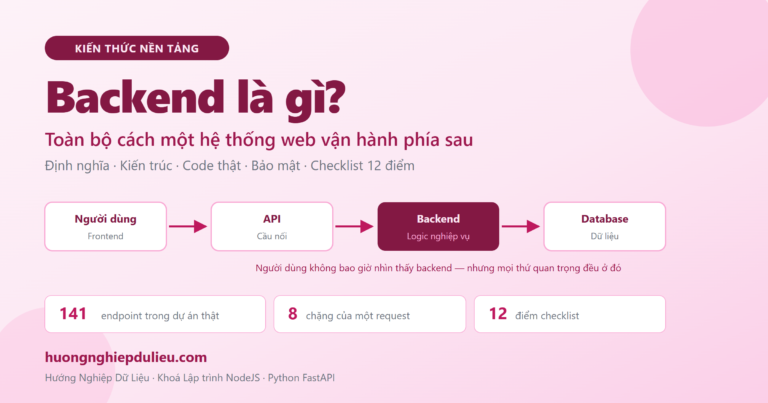
Backend là gì? Toàn bộ cách một hệ thống web vận hành phía sau
01/10/2026
Tin tức
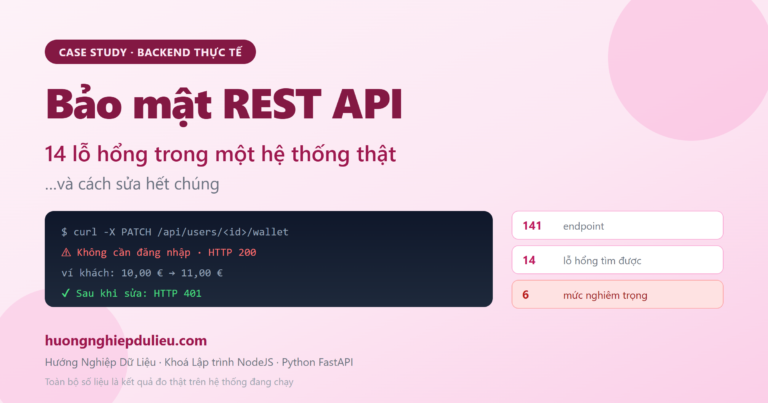
Bảo mật REST API: 14 lỗ hổng tôi tìm thấy trong một hệ thống thật và cách sửa hết
01/10/2026

Tin tức
FastAPI – Framework Python Hiện Đại Cho API Development
26/09/2026