Danh mục: Tin tức
Bài viết gần đây
-
-
Báo cáo cuối khóa MT5 K6: Phạm Ngọc Tuân demo EA Hedging 02/08
Tháng 8 2, 2026 -
Bot Auto Trading là gì? Hướng dẫn xây dựng bot thực chiến 2026
Tháng 8 2, 2026
| Phỏng vấn học viên: Anh Đào Trung Hiếu – Chuyển nghề thành công với Power BI & Python
Được viết bởi thanhdt vào ngày 13/11/2025 lúc 06:11 | 170 lượt xem
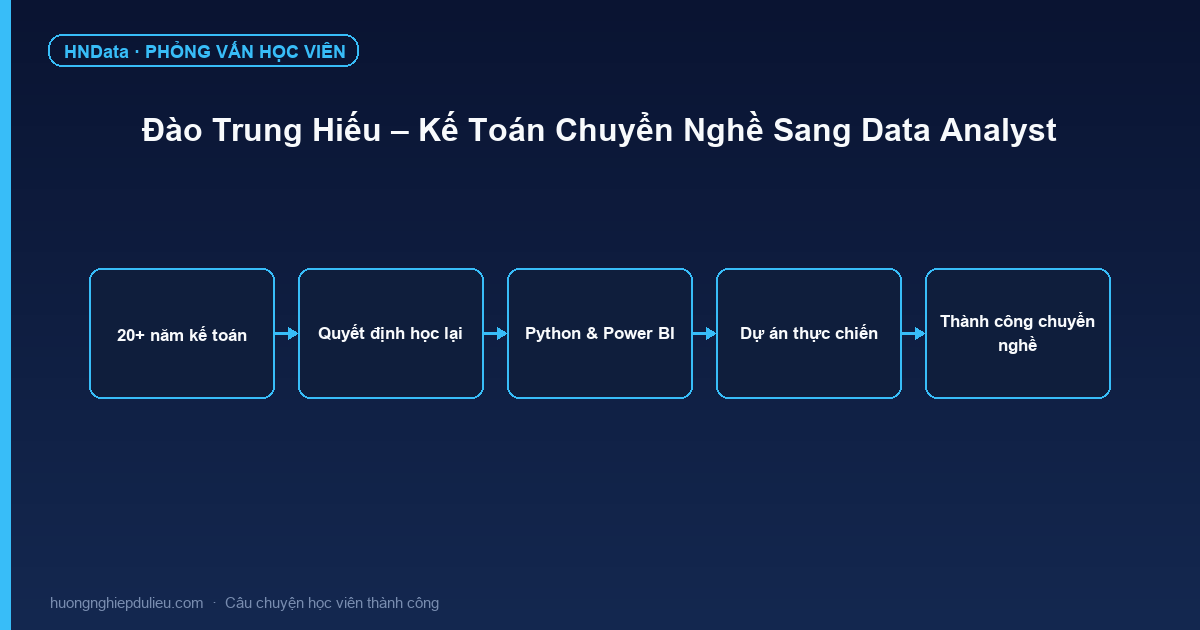
🎥 Phỏng vấn học viên: Anh Đào Trung Hiếu – từ kế toán 20 năm đến Data Analyst & Python Developer.
Câu chuyện chuyển đổi nghề nghiệp thành công nhờ Power BI & Python tại Hướng Nghiệp Dữ Liệu.
🎬 Video phỏng vấn đầy đủ
👋 Giới thiệu nhân vật
| 🎤 Người phỏng vấn | Nguyễn Thế Vinh |
| 👨💼 Học viên | Anh Đào Trung Hiếu |
| 📍 Hiện sống tại | 🇫🇮 Phần Lan |
| 🧑🎓 Học tại | Trung tâm Hướng Nghiệp Dữ Liệu |
| 📘 Khóa học đã tham gia |
|
💼 Bối cảnh: Từ Kế Toán 20 Năm Đến Quyết Định Học Lại
“Trước đây, tôi làm kế toán hơn 20 năm. Tuy nhiên, nếu không cập nhật công nghệ mới thì sẽ bị tụt hậu.
Power BI và Python không còn là công cụ của dân IT, mà trở thành kỹ năng bắt buộc với bất kỳ ai làm văn phòng.”
Anh Hiếu từng sử dụng Power BI Desktop từ năm 2017 tại Tân Hiệp Phát. Tuy nhiên, nhận thấy tốc độ phát triển của công nghệ ngày càng nhanh, anh quyết định học lại một cách bài bản để nắm chắc nền tảng và có thể áp dụng thực tế vào công việc:
- 🐍 Python: xử lý, phân tích và tự động hóa dữ liệu (backend)
- 📊 Power BI: trực quan hóa và trình bày dữ liệu (frontend báo cáo)
- 📱 Flutter: phát triển ứng dụng mobile đa nền tảng (mở rộng kỹ năng)
⭐ Điều Anh Hiếu Ấn Tượng Nhất Về Khóa Học
✅ 1. Giáo trình thực tế, chuyên sâu
Khóa học không dừng lại ở lý thuyết mà tập trung vào bài tập thực tế: xử lý file Excel, PDF, Word tự động; kết nối cơ sở dữ liệu; làm báo cáo bán hàng chuyên nghiệp.
✅ 2. Ứng dụng đa dạng, đo lường được kết quả
- Python: dùng OCR nhận dạng hóa đơn PDF, nhập liệu tự động vào hệ thống
- Power BI: tạo dashboard tương thích cả mobile và laptop, nhúng ML dự báo
✅ 3. Chất lượng giảng viên thực chiến
- 🧑💻 Thầy Tuấn (Python): hướng dẫn lập trình thực chiến và đóng gói phần mềm thành phẩm
- 👩🏫 Cô Nguyên (Power BI): dạy xây dựng ma trận chỉ tiêu và phân tích hệ thống báo cáo chuyên sâu
🧪 Anh Hiếu Đã Áp Dụng Kiến Thức Vào Thực Tế Như Thế Nào?
🔧 Dự án Python – Phần mềm Bán Hàng Cho Công Ty GSC (Long An)
Ngay sau khi hoàn thành khóa Python, anh Hiếu đã phát triển một phần mềm bán hàng thực tế với các tính năng:
- 📄 OCR tự động nhận diện hóa đơn PDF và trích xuất thông tin chính xác
- 🗄️ Upload dữ liệu JSON lên SQL Server theo thời gian thực
- 🖥️ Giao diện nhập liệu thân thiện, dễ vận hành cho nhân viên không chuyên IT
- ⚡ Tích hợp tự động hóa quy trình nhập liệu, tiết kiệm hàng chục giờ/tuần
📊 Dự án Power BI – Dashboard Bán Hàng Công Ty Sản Phẩm Golf
- 🏌️ Dashboard quản lý hơn 500 sản phẩm, kết nối trực tiếp từ hệ thống ERP
- 📱 Responsive hoàn hảo trên cả web và mobile
- 🤖 Tích hợp mô hình Machine Learning để dự báo doanh số hàng tháng
- 📈 Giúp ban lãnh đạo ra quyết định nhanh hơn dựa trên dữ liệu thực
🗺️ Hành Trình Chuyển Nghề Của Anh Hiếu – Timeline
2017 — Bắt đầu tiếp xúc Power BI Desktop tại Tân Hiệp Phát
2023–2024 — Nhận thấy công nghệ thay đổi nhanh, quyết định học lại bài bản
2024 — Hoàn thành 3 khóa học: Python, Flutter, Power BI tại HNDL
2025 — Triển khai dự án thực tế cho 2 doanh nghiệp ở Việt Nam từ Phần Lan
💬 Kết Luận & Lời Khuyên Cho Người Đang Cân Nhắc Học
Anh Đào Trung Hiếu là minh chứng sống động cho thấy không bao giờ là quá muộn để học công nghệ mới. Với nền tảng kế toán 20 năm, anh đã thêm vào đó sức mạnh của Python và Power BI để tạo ra giá trị thực tế cho doanh nghiệp — dù đang sinh sống ở nước ngoài.
“Nếu bạn đang làm văn phòng, hãy học Power BI & Python ngay từ hôm nay.
Đây không phải là kỹ năng của tương lai — đây là kỹ năng bắt buộc của hiện tại.”
— Anh Đào Trung Hiếu, Học viên HNDL
📌 Bạn Cũng Muốn Chuyển Nghề Thành Công?
Khám phá lộ trình học Python + Power BI thực chiến tại Hướng Nghiệp Dữ Liệu.
Đã có 1.000+ học viên chuyển nghề thành công.
Bài viết gần đây
-
Mua Bot Trade Forex: 7 Điều Phải Kiểm Tra Trước Khi Mua | HNDL
Tháng 8 2, 2026 -
Báo cáo cuối khóa MT5 K6: Phạm Ngọc Tuân demo EA Hedging 02/08
Tháng 8 2, 2026 -
Bot Auto Trading là gì? Hướng dẫn xây dựng bot thực chiến 2026
Tháng 8 2, 2026
| Flutter Backend API | Buổi 8 Lab Fintech HNDL
Được viết bởi thanhdt vào ngày 13/11/2025 lúc 06:11 | 160 lượt xem
Flutter Backend API | Buổi 8 Lab Fintech HNDL
📊 Phân tích danh mục đầu tư
Flutter Backend — kết nối app Flutter với API fintech
Flutter có thể tích hợp dễ dàng với các hệ thống backend phức tạp không?

Flutter đã và đang trở thành một trong những framework phát triển ứng dụng đa nền tảng phổ biến nhất hiện nay. Với khả năng tạo ra giao diện người dùng mượt mà và đẹp mắt, Flutter đang được nhiều doanh nghiệp và nhà phát triển lựa chọn. Tuy nhiên, một câu hỏi thường xuyên được đặt ra: Flutter có thể tích hợp dễ dàng với các hệ thống backend phức tạp không?
Khả năng tích hợp backend của Flutter
Flutter được thiết kế để tương thích với hầu hết các loại backend hiện đại. Dưới đây là những lý do chính khiến Flutter trở thành lựa chọn tuyệt vời cho việc tích hợp với các hệ thống backend phức tạp:
1. Hỗ trợ đa dạng các giao thức mạng
Flutter cung cấp thư viện http mạnh mẽ và linh hoạt cho phép:
- Thực hiện các yêu cầu HTTP/HTTPS (GET, POST, PUT, DELETE, PATCH)
- Xử lý header và cookie
- Tải file và upload dữ liệu
2. Hỗ trợ nhiều định dạng dữ liệu
Flutter có thể dễ dàng làm việc với nhiều định dạng dữ liệu phổ biến:
- JSON (thông qua thư viện
dart:converthoặcjson_serializable) - XML (thông qua package như
xml) - Protocol Buffers (thông qua package như
protobuf) - GraphQL (thông qua packages như
graphql_flutter)
3. Tích hợp với các nền tảng backend phổ biến
Flutter có thể tích hợp mượt mà với hầu hết các nền tảng backend:
RESTful APIs
import 'package:http/http.dart' as http;
import 'dart:convert';

Future<List<Product>> fetchProducts() async {
  final response = await http.get(Uri.parse('https://api.example.com/products'));

  if (response.statusCode == 200) {
    final List<dynamic> data = json.decode(response.body);
    return data.map((json) => Product.fromJson(json)).toList();
  } else {
    throw Exception('Failed to load products');
  }
}
GraphQL
import 'package:graphql_flutter/graphql_flutter.dart';

final GraphQLClient client = GraphQLClient(
  link: HttpLink('https://api.example.com/graphql'),
  cache: GraphQLCache(),
);

Future<List<Product>> fetchProducts() async {
  final QueryOptions options = QueryOptions(
    document: gql('''
      query GetProducts {
        products {
          id
          name
          price
        }
      }
    '''),
  );

  final QueryResult result = await client.query(options);

  if (result.hasException) {
    throw Exception(result.exception.toString());
  }

  final List<dynamic> data = result.data?['products'];
  return data.map((json) => Product.fromJson(json)).toList();
}
Firebase
import 'package:cloud_firestore/cloud_firestore.dart';

Future<List<Product>> fetchProducts() async {
  final QuerySnapshot snapshot =
      await FirebaseFirestore.instance.collection('products').get();

  return snapshot.docs.map((doc) =>
      Product.fromJson(doc.data() as Map<String, dynamic>)).toList();
}
4. Xử lý bất đồng bộ hiệu quả
Flutter và Dart cung cấp cơ chế xử lý bất đồng bộ mạnh mẽ thông qua:
Futurevàasync/awaitcho các tác vụ đơnStreamcho luồng dữ liệu liên tụcIsolatecho xử lý đa luồng
Ví dụ về xử lý Stream dữ liệu thời gian thực:
import 'package:cloud_firestore/cloud_firestore.dart';

Stream<List<Product>> streamProducts() {
  return FirebaseFirestore.instance
      .collection('products')
      .snapshots()
      .map((snapshot) =>
          snapshot.docs.map((doc) =>
              Product.fromJson(doc.data() as Map<String, dynamic>)).toList());
}

// Trong widget:
StreamBuilder<List<Product>>(
  stream: streamProducts(),
  builder: (context, snapshot) {
    if (snapshot.connectionState == ConnectionState.waiting) {
      return CircularProgressIndicator();
    }

    if (snapshot.hasError) {
      return Text('Error: ${snapshot.error}');
    }

    final products = snapshot.data!;
    return ListView.builder(
      itemCount: products.length,
      itemBuilder: (context, index) => ProductCard(product: products[index]),
    );
  },
)
Thách thức khi tích hợp với hệ thống backend phức tạp
Mặc dù Flutter có nhiều ưu điểm trong việc tích hợp backend, vẫn có một số thách thức cần lưu ý:
1. Quản lý trạng thái phức tạp
Khi ứng dụng tương tác với backend phức tạp, việc quản lý trạng thái có thể trở nên khó khăn. Các giải pháp bao gồm:
- Provider/Riverpod: Cho các ứng dụng vừa và nhỏ
- Bloc/Cubit: Cho các ứng dụng lớn với logic phức tạp
- Redux: Cho các ứng dụng cần trạng thái tập trung và có thể dự đoán
- GetX: Cho các ứng dụng cần giải pháp “tất cả trong một”
2. Xử lý authentication và authorization
Hầu hết các hệ thống backend phức tạp đều yêu cầu xác thực và phân quyền. Flutter có thể xử lý điều này thông qua:
- JWT (JSON Web Tokens)
- OAuth 2.0
- Xác thực dựa trên session
- Xác thực đa yếu tố
Ví dụ về JWT Authentication:
import 'package:http/http.dart' as http;
import 'package:shared_preferences/shared_preferences.dart';
import 'dart:convert';

class AuthService {
  final String baseUrl = 'https://api.example.com';

  Future<bool> login(String username, String password) async {
    final response = await http.post(
      Uri.parse('$baseUrl/login'),
      body: {
        'username': username,
        'password': password,
      },
    );

    if (response.statusCode == 200) {
      final data = json.decode(response.body);
      final token = data['token'];

      // Lưu token vào storage
      final prefs = await SharedPreferences.getInstance();
      await prefs.setString('auth_token', token);

      return true;
    }

    return false;
  }

  Future<String?> getToken() async {
    final prefs = await SharedPreferences.getInstance();
    return prefs.getString('auth_token');
  }

  Future<Map<String, String>> getAuthHeaders() async {
    final token = await getToken();
    return {
      'Authorization': 'Bearer $token',
      'Content-Type': 'application/json',
    };
  }

  Future<void> logout() async {
    final prefs = await SharedPreferences.getInstance();
    await prefs.remove('auth_token');
  }
}
3. Xử lý offline và đồng bộ hóa
Các ứng dụng di động thường phải đối mặt với kết nối mạng không ổn định. Flutter cung cấp nhiều giải pháp:
- Hive/SQLite: Lưu trữ dữ liệu cục bộ
- WorkManager: Xử lý đồng bộ hóa nền
- Connectivity package: Theo dõi trạng thái kết nối
- Custom sync logic: Giải quyết xung đột và hợp nhất dữ liệu
4. Hiệu suất khi xử lý dữ liệu lớn
Khi làm việc với dữ liệu lớn từ backend phức tạp, hiệu suất có thể bị ảnh hưởng. Các chiến lược tối ưu bao gồm:
- Phân trang và tải dữ liệu theo nhu cầu
- Nén dữ liệu gửi đi/nhận về
- Sử dụng cache thông minh
- Tính toán trên Isolate riêng biệt
Các giải pháp backend tốt nhất cho Flutter
Dựa trên kinh nghiệm, một số giải pháp backend hoạt động đặc biệt tốt với Flutter:
1. Firebase
Firebase cung cấp tích hợp mượt mà với Flutter thông qua packages chính thức. Các dịch vụ bao gồm:
- Firestore (cơ sở dữ liệu NoSQL thời gian thực)
- Authentication (nhiều phương thức xác thực)
- Storage (lưu trữ tệp)
- Functions (serverless computing)
- Messaging (thông báo đẩy)
2. REST APIs với Node.js/Express, Django, Rails
Các nền tảng backend truyền thống như Node.js, Django, và Rails hoạt động rất tốt với Flutter thông qua API RESTful.
3. GraphQL với Apollo Server hoặc Hasura
GraphQL cung cấp hiệu quả truy vấn dữ liệu cao và là lựa chọn tuyệt vời cho ứng dụng Flutter phức tạp.
4. Supabase hoặc Appwrite
Các giải pháp backend as a service mã nguồn mở này cung cấp nhiều tính năng tương tự Firebase nhưng với nhiều tùy chọn tự host hơn.
Chiến lược tích hợp backend hiệu quả trong dự án Flutter
Dưới đây là một số nguyên tắc để tích hợp backend hiệu quả trong dự án Flutter:
1. Sử dụng kiến trúc repository
Tách biệt hoàn toàn logic truy cập dữ liệu khỏi UI:
// Định nghĩa contract
abstract class ProductRepository {
  Future<List<Product>> getProducts();
  Future<Product> getProduct(String id);
  Future<void> createProduct(Product product);
  Future<void> updateProduct(Product product);
  Future<void> deleteProduct(String id);
}

// Triển khai cho API REST
class ApiProductRepository implements ProductRepository {
  final http.Client client;

  ApiProductRepository(this.client);

  @override
  Future<List<Product>> getProducts() async {
    // Triển khai API
  }

  // Triển khai các phương thức khác
}

// Triển khai cho Firestore
class FirestoreProductRepository implements ProductRepository {
  final FirebaseFirestore firestore;

  FirestoreProductRepository(this.firestore);

  @override
  Future<List<Product>> getProducts() async {
    // Triển khai Firestore
  }

  // Triển khai các phương thức khác
}
2. Tự động tạo mã từ Swagger/OpenAPI
Sử dụng công cụ như openapi_generator để tự động tạo mã Dart từ tài liệu API.
3. Sử dụng Dio thay vì http
Thư viện Dio cung cấp nhiều tính năng nâng cao hơn:
- Interceptor cho token refresh
- Transformers cho xử lý dữ liệu
- Cancel token cho hủy yêu cầu
- Tiến trình tải xuống/tải lên
- FormData cho multipart request
import 'package:dio/dio.dart';

final dio = Dio();

dio.interceptors.add(
  InterceptorsWrapper(
    onRequest: (options, handler) async {
      // Thêm token vào header
      final token = await getToken();
      options.headers['Authorization'] = 'Bearer $token';
      return handler.next(options);
    },
    onError: (DioError error, handler) async {
      if (error.response?.statusCode == 401) {
        // Token hết hạn, làm mới token
        if (await refreshToken()) {
          // Thử lại yêu cầu
          return handler.resolve(await dio.fetch(error.requestOptions));
        }
      }
      return handler.next(error);
    },
  ),
);
4. Sử dụng JSON serialization tự động
Thay vì viết thủ công phương thức fromJson và toJson, sử dụng json_serializable:
import 'package:json_annotation/json_annotation.dart';

part 'product.g.dart';

@JsonSerializable()
class Product {
  final String id;
  final String name;
  final double price;
  final String description;
  final String imageUrl;

  Product({
    required this.id,
    required this.name,
    required this.price,
    required this.description,
    required this.imageUrl,
  });

  factory Product.fromJson(Map<String, dynamic> json) =>
      _$ProductFromJson(json);

  Map<String, dynamic> toJson() => _$ProductToJson(this);
}
Kết luận
Flutter không chỉ là một framework UI mạnh mẽ mà còn đặc biệt hiệu quả trong việc tích hợp với các hệ thống backend phức tạp. Với sự hỗ trợ đa dạng các giao thức mạng, định dạng dữ liệu và nền tảng backend, Flutter cung cấp tính linh hoạt cao cho các nhà phát triển.
Mặc dù có một số thách thức khi làm việc với backend phức tạp, Flutter cung cấp nhiều giải pháp để giải quyết những vấn đề này. Bằng cách áp dụng các mẫu kiến trúc phù hợp, sử dụng thư viện hiệu quả và tuân theo các nguyên tắc lập trình tốt, các nhà phát triển có thể tạo ra các ứng dụng Flutter mạnh mẽ với tích hợp backend vững chắc.
Với sự phát triển liên tục của hệ sinh thái Dart và Flutter, khả năng tích hợp backend ngày càng mạnh mẽ hơn, khiến nó trở thành lựa chọn tuyệt vời cho cả ứng dụng đơn giản và phức tạp.
Bạn đã có kinh nghiệm tích hợp Flutter với hệ thống backend phức tạp chưa? Chia sẻ câu chuyện và những bài học kinh nghiệm của bạn trong phần bình luận bên dưới!
Bài viết gần đây
-
Mua Bot Trade Forex: 7 Điều Phải Kiểm Tra Trước Khi Mua | HNDL
Tháng 8 2, 2026 -
Báo cáo cuối khóa MT5 K6: Phạm Ngọc Tuân demo EA Hedging 02/08
Tháng 8 2, 2026 -
Bot Auto Trading là gì? Hướng dẫn xây dựng bot thực chiến 2026
Tháng 8 2, 2026
| 🚀 Cơ bản về Flutter & Dart
Được viết bởi thanhdt vào ngày 13/11/2025 lúc 06:11 | 125 lượt xem
🚀 Cơ bản về Flutter & Dart
📊 Phân tích danh mục đầu tư
🚀 Cơ bản về Flutter & Dart
Làm quen với ngôn ngữ Dart dành cho lập trình Flutter

Mục lục
- Giới thiệu
- Ngôn ngữ Dart – Nền tảng của Flutter
- Cấu trúc cơ bản trong Dart
- Flutter Widgets – Xây dựng UI
- Xây dựng ứng dụng đầu tiên
- Các tips và thực hành tốt nhất
- Kết luận
Giới thiệu
Flutter là framework phát triển ứng dụng di động đa nền tảng do Google phát triển, cho phép lập trình viên tạo ra các ứng dụng đẹp, nhanh và hoạt động trên nhiều nền tảng (iOS, Android, Web, Desktop) từ cùng một codebase. Trung tâm của Flutter là ngôn ngữ lập trình Dart, cũng được phát triển bởi Google.
Bài viết này sẽ giới thiệu cơ bản về Dart và Flutter, giúp bạn có cái nhìn tổng quan về cách phát triển ứng dụng với công nghệ hiện đại này.
Ngôn ngữ Dart – Nền tảng của Flutter
Dart là một ngôn ngữ lập trình hướng đối tượng được phát triển bởi Google. Nó được thiết kế để dễ học, đặc biệt là đối với các lập trình viên đã quen thuộc với C#, Java hoặc JavaScript.
Những đặc điểm chính của Dart:
-
Strongly typed: Dart là ngôn ngữ được định kiểu mạnh, giúp phát hiện lỗi sớm trong quá trình phát triển.
-
Null safety: Từ Dart 2.12, ngôn ngữ này hỗ trợ null safety, giúp tránh các lỗi liên quan đến null reference.
-
Async/await: Dart cung cấp cú pháp async/await để xử lý bất đồng bộ một cách dễ dàng.
-
JIT và AOT compilation: Dart hỗ trợ cả Just-In-Time (JIT) để phát triển nhanh và Ahead-Of-Time (AOT) để triển khai hiệu quả.
Cú pháp cơ bản trong Dart:
// Biến và kiểu dữ liệu
String name = 'Flutter';
int age = 5;
double version = 3.10;
bool isAwesome = true;
var dynamicType = 'Tự động xác định kiểu';

// Danh sách và Collections
List<String> frameworks = ['Flutter', 'React Native', 'Xamarin'];
Map<String, String> languageCreators = {
  'Dart': 'Google',
  'Swift': 'Apple',
  'Kotlin': 'JetBrains'
};

// Hàm
int add(int a, int b) {
  return a + b;
}

// Arrow function (Lambda)
int subtract(int a, int b) => a - b;

// Lớp và đối tượng
class Person {
  String name;
  int age;

  // Constructor
  Person(this.name, this.age);

  // Method
  void introduce() {
    print('Xin chào, tôi là $name và tôi $age tuổi.');
  }
}

// Sử dụng async/await
Future<void> fetchData() async {
  try {
    var result = await getDataFromServer();
    print(result);
  } catch (e) {
    print('Lỗi: $e');
  }
}
Cấu trúc cơ bản trong Dart
1. Biến và kiểu dữ liệu
Dart có các kiểu dữ liệu cơ bản như:
int: Số nguyêndouble: Số thựcString: Chuỗibool: Boolean (true/false)List: Danh sáchSet: Tập hợpMap: Từ điển (key-value)
Khi khai báo biến, bạn có thể chỉ định kiểu rõ ràng hoặc sử dụng từ khóa var để Dart tự suy luận kiểu:
// Chỉ định kiểu rõ ràng
String name = 'Nguyen Van A';

// Tự suy luận kiểu
var age = 30; // age sẽ có kiểu int
Với Null Safety, bạn cần sử dụng dấu ? để chỉ định rằng một biến có thể nhận giá trị null:
String? nullableName; // Có thể null
String nonNullableName = 'Flutter'; // Không thể null
2. Hàm và phương thức
Cú pháp định nghĩa hàm trong Dart:
// Hàm cơ bản
int sum(int a, int b) {
  return a + b;
}

// Arrow function
int multiply(int a, int b) => a * b;

// Tham số tùy chọn
void greet(String name, {String greeting = 'Xin chào'}) {
  print('$greeting, $name!');
}

// Gọi hàm với tham số tùy chọn
greet('Flutter'); // Output: Xin chào, Flutter!
greet('Dart', greeting: 'Chào mừng'); // Output: Chào mừng, Dart!
3. Lớp và đối tượng
Dart là ngôn ngữ hướng đối tượng, hỗ trợ đầy đủ các tính năng như kế thừa, đa hình, trừu tượng và đóng gói:
// Định nghĩa lớp
class Developer {
  String name;
  List<String> skills;

  // Constructor
  Developer(this.name, this.skills);

  // Named constructor
  Developer.junior(String name) : this(name, ['Dart', 'Flutter']);

  // Method
  void introduce() {
    print('Tôi là $name và tôi biết: ${skills.join(', ')}');
  }
}

// Kế thừa
class SeniorDeveloper extends Developer {
  int experienceYears;

  SeniorDeveloper(String name, List<String> skills, this.experienceYears)
      : super(name, skills);

  // Ghi đè phương thức
  @override
  void introduce() {
    print('Senior Dev $name với $experienceYears năm kinh nghiệm.');
    print('Kỹ năng: ${skills.join(', ')}');
  }
}

// Sử dụng
var dev = Developer('An', ['Flutter', 'Firebase']);
dev.introduce();

var senior = SeniorDeveloper('Binh', ['Flutter', 'Dart', 'Firebase', 'AWS'], 5);
senior.introduce();
Flutter Widgets – Xây dựng UI

Flutter sử dụng một paradigm gọi là “Everything is a Widget”. Tất cả UI trong Flutter được xây dựng bằng cách kết hợp các widget lại với nhau.
Các loại widget chính:
- Stateless Widgets: Widgets không có trạng thái, không thay đổi sau khi được xây dựng.
class WelcomeCard extends StatelessWidget {
  final String name;

  const WelcomeCard({Key? key, required this.name}) : super(key: key);

  @override
  Widget build(BuildContext context) {
    return Card(
      child: Padding(
        padding: const EdgeInsets.all(16.0),
        child: Text('Chào mừng, $name!'),
      ),
    );
  }
}- Stateful Widgets: Widgets có trạng thái nội bộ, có thể thay đổi trong vòng đời của widget.
class Counter extends StatefulWidget {
  const Counter({Key? key}) : super(key: key);

  @override
  _CounterState createState() => _CounterState();
}

class _CounterState extends State<Counter> {
  int _count = 0;

  void _increment() {
    setState(() {
      _count++;
    });
  }

  @override
  Widget build(BuildContext context) {
    return Column(
      children: [
        Text('Số lần nhấn: $_count'),
        ElevatedButton(
          onPressed: _increment,
          child: Text('Tăng'),
        ),
      ],
    );
  }
}
Các widget thông dụng:
- Container: Widget đa năng cho phép tùy chỉnh kích thước, padding, margin và trang trí.
- Row, Column: Sắp xếp các widget con theo chiều ngang hoặc dọc.
- Stack: Xếp chồng các widget lên nhau.
- ListView: Hiển thị danh sách các widget có thể cuộn.
- GridView: Hiển thị lưới các widget.
- Text: Hiển thị văn bản có thể tùy chỉnh.
- Image: Hiển thị hình ảnh.
- Button: Các loại nút như ElevatedButton, TextButton, OutlinedButton.
Ví dụ về bố cục UI:
@override
Widget build(BuildContext context) {
  return Scaffold(
    appBar: AppBar(
      title: Text('Ứng dụng Flutter'),
    ),
    body: Column(
      children: [
        // Header section
        Container(
          color: Colors.blue[100],
          padding: EdgeInsets.all(16.0),
          child: Row(
            children: [
              CircleAvatar(
                radius: 30,
                backgroundImage: AssetImage('assets/avatar.png'),
              ),
              SizedBox(width: 16),
              Column(
                crossAxisAlignment: CrossAxisAlignment.start,
                children: [
                  Text(
                    'Nguyen Van A',
                    style: TextStyle(fontSize: 18, fontWeight: FontWeight.bold),
                  ),
                  Text('Flutter Developer'),
                ],
              ),
            ],
          ),
        ),

        // Content section
        Expanded(
          child: ListView.builder(
            itemCount: 20,
            itemBuilder: (context, index) {
              return ListTile(
                leading: Icon(Icons.article),
                title: Text('Bài viết ${index + 1}'),
                subtitle: Text('Mô tả ngắn về bài viết'),
                onTap: () {
                  // Xử lý khi nhấn vào item
                },
              );
            },
          ),
        ),
      ],
    ),
    floatingActionButton: FloatingActionButton(
      onPressed: () {
        // Xử lý khi nhấn nút
      },
      child: Icon(Icons.add),
    ),
  );
}
Xây dựng ứng dụng đầu tiên

Để tạo một ứng dụng Flutter đơn giản, hãy thực hiện các bước sau:
1. Cài đặt Flutter SDK
# Tải và cài đặt Flutter SDK từ https://flutter.dev/docs/get-started/install
# Sau khi cài đặt, kiểm tra cài đặt
flutter doctor
2. Tạo dự án mới
flutter create my_first_app
cd my_first_app
3. Cấu trúc dự án Flutter
my_first_app/
├── android/          # Mã nguồn Android
├── ios/              # Mã nguồn iOS
├── lib/              # Mã nguồn Dart
│   └── main.dart     # File chính của ứng dụng
├── test/             # Thư mục kiểm thử
├── pubspec.yaml      # Khai báo dependencies
└── README.md
4. File main.dart cơ bản
import 'package:flutter/material.dart';

void main() {
  runApp(MyApp());
}

class MyApp extends StatelessWidget {
  @override
  Widget build(BuildContext context) {
    return MaterialApp(
      title: 'Ứng dụng đầu tiên',
      theme: ThemeData(
        primarySwatch: Colors.blue,
      ),
      home: MyHomePage(title: 'Trang chủ Flutter'),
    );
  }
}

class MyHomePage extends StatefulWidget {
  MyHomePage({Key? key, required this.title}) : super(key: key);

  final String title;

  @override
  _MyHomePageState createState() => _MyHomePageState();
}

class _MyHomePageState extends State<MyHomePage> {
  int _counter = 0;

  void _incrementCounter() {
    setState(() {
      _counter++;
    });
  }

  @override
  Widget build(BuildContext context) {
    return Scaffold(
      appBar: AppBar(
        title: Text(widget.title),
      ),
      body: Center(
        child: Column(
          mainAxisAlignment: MainAxisAlignment.center,
          children: <Widget>[
            Text(
              'Bạn đã nhấn nút:',
            ),
            Text(
              '$_counter',
              style: Theme.of(context).textTheme.headline4,
            ),
          ],
        ),
      ),
      floatingActionButton: FloatingActionButton(
        onPressed: _incrementCounter,
        tooltip: 'Tăng',
        child: Icon(Icons.add),
      ),
    );
  }
}
5. Chạy ứng dụng
flutter runCác tips và thực hành tốt nhất
-
State Management: Sử dụng các giải pháp quản lý trạng thái như Provider, Riverpod, Bloc, GetX để quản lý trạng thái ứng dụng một cách hiệu quả.
-
Cấu trúc dự án: Tổ chức mã nguồn theo các lớp logic như:
lib/models/: Các model dữ liệulib/screens/: Các màn hình UIlib/widgets/: Các widget tái sử dụnglib/services/: Các dịch vụ (API, database, authentication)lib/utils/: Các hàm tiện ích
-
Tách biệt UI và Logic: Sử dụng các mẫu thiết kế như MVVM, Repository để tách biệt UI và business logic.
-
Responsive UI: Sử dụng MediaQuery, LayoutBuilder để xây dựng UI thích ứng với nhiều kích thước màn hình.
-
Code style: Tuân thủ quy tắc đặt tên và cấu trúc mã nguồn của Dart.
// Sử dụng camelCase cho biến và hàm
String userName;
void fetchUserData() { ... }

// Sử dụng PascalCase cho lớp
class UserRepository { ... }

// Sử dụng lowerCamelCase cho tham số hàm
void updateUser({required String firstName, String? lastName}) { ... }- Optimization: Sử dụng
constconstructor khi có thể để tối ưu hiệu suất rebuild.
// Thay vì
Container(
  color: Colors.blue,
  child: Text('Hello'),
)

// Sử dụng const
const Container(
  color: Colors.blue,
  child: Text('Hello'),
)
Kết luận
Dart và Flutter cung cấp một cách tiếp cận hiện đại và hiệu quả để phát triển ứng dụng đa nền tảng. Với cú pháp rõ ràng của Dart và hệ thống widget mạnh mẽ của Flutter, bạn có thể tạo ra các ứng dụng đẹp, nhanh và có thể chạy trên nhiều nền tảng từ cùng một codebase.
Đây chỉ là những kiến thức cơ bản để bắt đầu với Flutter và Dart. Để trở thành một nhà phát triển Flutter chuyên nghiệp, bạn cần thực hành và khám phá thêm nhiều tính năng nâng cao như:
- Animation và Transitions
- Navigation và Routing
- Internationalization
- Testing
- Firebase integration
- Custom Widgets và Platform Channels
Hãy bắt đầu hành trình khám phá Flutter và Dart ngay hôm nay!
Bài viết gần đây
-
Mua Bot Trade Forex: 7 Điều Phải Kiểm Tra Trước Khi Mua | HNDL
Tháng 8 2, 2026 -
Báo cáo cuối khóa MT5 K6: Phạm Ngọc Tuân demo EA Hedging 02/08
Tháng 8 2, 2026 -
Bot Auto Trading là gì? Hướng dẫn xây dựng bot thực chiến 2026
Tháng 8 2, 2026
| Backtest là gì? Vì sao backtest không đủ để đánh giá mô hình?
Được viết bởi thanhdt vào ngày 13/11/2025 lúc 06:11 | 190 lượt xem
Backtest là gì? Vì sao backtest không đủ để đánh giá mô hình?
📊 Phân tích danh mục đầu tư
📊 Backtest là gì? Vì sao backtest không đủ để đánh giá mô hình?
Backtest là một bước quan trọng trong quá trình phát triển và kiểm tra chiến lược giao dịch. Tuy nhiên, nếu chỉ dựa vào kết quả backtest trên dữ liệu quá khứ, bạn rất dễ rơi vào “ảo tưởng chiến thắng”. Để đánh giá mô hình một cách toàn diện, bạn cần hiểu rõ các rủi ro như overfitting và tầm quan trọng của kiểm tra out-of-sample.
1. Backtest là gì?
Backtest là quá trình kiểm tra một chiến lược giao dịch hoặc mô hình dự báo trên dữ liệu lịch sử. Bạn áp dụng các quy tắc/mô hình của mình lên dữ liệu quá khứ để xem nếu áp dụng trong thực tế thì kết quả sẽ ra sao.

Các bước cơ bản của backtest:
- Xây dựng chiến lược/mô hình giao dịch.
- Áp dụng mô hình lên dữ liệu lịch sử (in-sample).
- Đánh giá kết quả: lợi nhuận, drawdown, tỷ lệ thắng, v.v.
2. Vì sao backtest không đủ để đánh giá mô hình?
a. Nguy cơ ảo tưởng từ dữ liệu quá khứ
- Thị trường luôn thay đổi, những gì hiệu quả trong quá khứ chưa chắc sẽ hiệu quả trong tương lai.
- Nếu chỉ tối ưu mô hình cho dữ liệu lịch sử, bạn dễ rơi vào bẫy overfitting.
b. Overfitting là gì?
Overfitting là hiện tượng mô hình “học vẹt” dữ liệu quá khứ, ghi nhớ chi tiết nhiễu thay vì học quy luật tổng quát. Khi gặp dữ liệu mới, mô hình này thường hoạt động kém hiệu quả.
Dấu hiệu nhận biết:
- Kết quả backtest rất tốt, nhưng khi áp dụng thực tế lại thua lỗ.
- Mô hình quá phức tạp, có quá nhiều tham số hoặc quy tắc.
c. Tầm quan trọng của kiểm tra out-of-sample
Để đánh giá mô hình thực sự, bạn cần kiểm tra trên dữ liệu out-of-sample (dữ liệu chưa từng dùng để xây dựng mô hình).
Quy trình chuẩn:
- Chia dữ liệu thành hai phần: in-sample (dùng để xây dựng và tối ưu mô hình) và out-of-sample (dùng để kiểm tra).
- Chỉ đánh giá hiệu quả mô hình trên out-of-sample mới biết được khả năng tổng quát hóa.
3. Lời khuyên khi đánh giá mô hình giao dịch
- Luôn chia dữ liệu thành in-sample và out-of-sample.
- Không tối ưu quá mức cho dữ liệu quá khứ.
- Kết hợp backtest với forward test (test trên dữ liệu mới, thời gian thực).
- Đánh giá mô hình bằng nhiều chỉ số, không chỉ lợi nhuận.
Tóm tắt
Backtest là bước bắt buộc, nhưng không đủ để đánh giá mô hình. Hãy cẩn trọng với overfitting và luôn kiểm tra out-of-sample để đảm bảo mô hình của bạn thực sự hiệu quả trong thực tế.
Tài liệu tham khảo
Bài viết gần đây
-
Mua Bot Trade Forex: 7 Điều Phải Kiểm Tra Trước Khi Mua | HNDL
Tháng 8 2, 2026 -
Báo cáo cuối khóa MT5 K6: Phạm Ngọc Tuân demo EA Hedging 02/08
Tháng 8 2, 2026 -
Bot Auto Trading là gì? Hướng dẫn xây dựng bot thực chiến 2026
Tháng 8 2, 2026
| Thuật Toán Baum-Welch – Người Tiền Phong Của Machine Learning
Được viết bởi thanhdt vào ngày 13/11/2025 lúc 06:11 | 215 lượt xem
Thuật toán Baum-Welch, được đồng phát triển bởi Leonard “Lenny” Baum, không chỉ là một cột mốc quan trọng trong lịch sử Machine Learning mà còn là nền tảng cho phương pháp giao dịch định lượng tại Renaissance Technologies – quỹ đầu cơ thành công nhất mọi thời đại. Từ việc giải mã mật mã trong Chiến tranh Lạnh đến dự đoán chuyển động giá trên thị trường tài chính, thuật toán này đã thay đổi cách chúng ta hiểu và khai thác dữ liệu.
🧬 Nguồn Gốc Toán Học
Leonard “Lenny” Baum – Nhà Toán Học Thiên Tài
Background:
Leonard E. Baum (1931-2017)

Education:
- PhD Mathematics, Harvard University (1958)
- Chuyên ngành: Probability Theory, Statistics

Career:
- 1960s: Institute for Defense Analyses (IDA)
- Codebreaker cho NSA
- Sau này: Đối tác đầu tiên của Jim Simons
Vai trò tại Renaissance:
Lenny Baum là đối tác đầu tư đầu tiên của James Simons tại công ty Monemetrics (tiền thân của Renaissance Technologies, thành lập 1978).
Partnership:
Jim Simons (geometry, codebreaker)
+ Lenny Baum (probability, statistics)
= Quantitative trading pioneers
Connection:
Cả Simons và Baum đều từng làm việc trong lĩnh vực cryptography và codebreaking, nơi họ học cách:
- Tìm patterns trong noise
- Xử lý massive datasets
- Áp dụng toán học vào bài toán thực tế
- Giữ bí mật tuyệt đối
Sự Hợp Tác Với Lloyd Welch
Thập niên 1960s – Institute for Defense Analyses (IDA)
Lloyd Welch:
Lloyd R. Welch (1927-2013)

Background:
- Electrical engineer & information theorist
- Pioneer in coding theory
- Worked on error-correcting codes

Famous for:
- Viterbi algorithm (với Andrew Viterbi)
- Baum-Welch algorithm (với Leonard Baum)
Collaboration context:
Cold War era (1960s):
- US military needs better codebreaking
- Speech recognition for surveillance
- Pattern recognition in communications

IDA mission:
→ Develop mathematical tools for defense
→ Analyze complex signals
→ Decrypt enemy communications
The problem they solved:
Challenge:
"How do we model systems where we can see
 the outputs but not the internal states?"

Examples:
- Speech: Hear sounds, but don't see tongue position
- Markets: See prices, but don't see trader intentions
- Communications: Intercept signals, but don't know original message

Solution:
→ Hidden Markov Models (HMM)
→ Baum-Welch algorithm to train them
🔗 Chuỗi Markov và Mô Hình Ẩn
Markov Chains (Chuỗi Markov)
Định nghĩa:
Chuỗi Markov là một chuỗi sự kiện mà xác suất của sự kiện tiếp theo chỉ phụ thuộc vào trạng thái hiện tại, chứ không phải các sự kiện trước đó.
“Markov Property” (Tính chất Markov):
“The future is independent of the past, given the present.”
Ví dụ đơn giản: Thời tiết
States: {Sunny, Rainy, Cloudy}

Transition probabilities:

If today is Sunny:
  Tomorrow: 70% Sunny, 20% Cloudy, 10% Rainy

If today is Rainy:
  Tomorrow: 20% Sunny, 30% Cloudy, 50% Rainy

If today is Cloudy:
  Tomorrow: 40% Sunny, 40% Cloudy, 20% Rainy

Key insight:
Tomorrow's weather ONLY depends on today's weather,
NOT on yesterday's, last week's, etc.
Biểu diễn toán học:
P(X_t+1 = s_j | X_t = s_i, X_t-1, X_t-2, ..., X_0)
= P(X_t+1 = s_j | X_t = s_i)

Only current state matters!
Transition matrix:
         Sunny  Rainy  Cloudy
Sunny  [  0.7    0.1    0.2  ]
Rainy  [  0.2    0.5    0.3  ]
Cloudy [  0.4    0.2    0.4  ]

Each row sums to 1.0 (probabilities)
Ví dụ trong tài chính: Bull/Bear markets
States: {Bull Market, Bear Market, Sideways}

If current = Bull:
  Next month: 70% Bull, 10% Bear, 20% Sideways

If current = Bear:
  Next month: 30% Bull, 50% Bear, 20% Sideways

Simple Markov model of market regimes
Hidden Markov Models (HMM)
Vấn đề với Markov Chains thông thường:
Problem:
"What if we can't observe the states directly?"

Real-world scenarios:

1. Speech recognition:
   Observable: Sound waves
   Hidden: Phonemes, words being spoken

2. Stock markets:
   Observable: Prices, volume
   Hidden: Market regime (bull/bear), trader sentiment

3. Weather (more realistic):
   Observable: Temperature, humidity readings
   Hidden: Actual weather system (high/low pressure)
Hidden Markov Model structure:
Hidden States (unobservable):
S1 → S2 → S3 → S4 → ...

 ↓    ↓    ↓    ↓

Observable Outputs:
O1   O2   O3   O4   ...

We see: O1, O2, O3, O4
We don't see: S1, S2, S3, S4
We want to infer: S1, S2, S3, S4
Ví dụ cụ thể: Market regimes
Hidden States: {Accumulation, Markup, Distribution, Markdown}

Observable: Price & Volume

Accumulation phase:
  → Hidden state: Smart money buying
  → Observable: Low volume, prices flat/slightly up
  → Emission: 60% low_vol_up, 30% low_vol_flat, 10% low_vol_down

Markup phase:
  → Hidden state: Rally
  → Observable: High volume, prices rising
  → Emission: 70% high_vol_up, 20% med_vol_up, 10% high_vol_flat

Distribution phase:
  → Hidden state: Smart money selling
  → Observable: High volume, prices topping
  → Emission: 40% high_vol_up, 40% high_vol_flat, 20% high_vol_down

Markdown phase:
  → Hidden state: Decline
  → Observable: High volume, prices falling
  → Emission: 80% high_vol_down, 15% med_vol_down, 5% low_vol_down
Three key problems for HMM:
1. Evaluation:
   Given model parameters and observations,
   what's the probability of this sequence?
   → Forward algorithm

2. Decoding:
   Given observations, what's the most likely
   sequence of hidden states?
   → Viterbi algorithm

3. Learning:
   Given observations, what are the best
   model parameters (transitions, emissions)?
   → Baum-Welch algorithm ⭐
Tại Sao HMM Quan Trọng?
Modeling the “unobservable”:
Trong thế giới thực, chúng ta thường:
- Thấy effects (kết quả)
- Không thấy causes (nguyên nhân)
HMM giúp infer causes from effects.
Applications:
1. Speech Recognition:
Hidden: Words being spoken
Observable: Sound frequencies

HMM learns:
"When I hear THIS sound pattern,
 it's probably THAT word"
2. Bioinformatics:
Hidden: Gene structure (exons, introns)
Observable: DNA sequence

HMM finds:
"Where are the genes in this DNA?"
3. Financial Markets:
Hidden: Market regime, trader intent
Observable: Price, volume, order flow

HMM predicts:
"Market is probably in accumulation phase
 → Expect markup soon → Buy now"
4. Natural Language Processing:
Hidden: Parts of speech (noun, verb, etc.)
Observable: Words in sentence

HMM tags:
"This word is probably a noun"
🧮 Thuật Toán Baum-Welch
Cách Hoạt Động (High-Level)
The learning problem:
Given:
- Observable sequence: O = [O1, O2, O3, ..., OT]
- Number of hidden states: N

Find:
- Transition probabilities: A[i][j] = P(S_t+1=j | S_t=i)
- Emission probabilities: B[i][k] = P(O_t=k | S_t=i)
- Initial probabilities: π[i] = P(S_0=i)

Such that:
P(O | model) is maximized
(Model explains observations best)
Iterative approach:
Baum-Welch is an EM algorithm:
(Expectation-Maximization)

Step 1: Initialize parameters randomly
        (or with educated guess)

Step 2: Expectation (E-step)
        Given current parameters,
        estimate hidden state probabilities

Step 3: Maximization (M-step)
        Given estimated states,
        update parameters to maximize likelihood

Step 4: Repeat until convergence
        (likelihood stops improving)
Visual intuition:
Iteration 0:
Parameters: Random guesses
Likelihood: Low (model doesn't fit data)

Iteration 1:
E-step: Estimate states given bad parameters
M-step: Improve parameters based on estimates
Likelihood: Better

Iteration 2:
E-step: Estimate states given better parameters
M-step: Further improve parameters
Likelihood: Even better

...

Iteration 100:
Parameters: Converged
Likelihood: Maximized (or local maximum)
Model now fits data well!
Mathematics (Simplified)
Notation:
N = number of hidden states
M = number of observable symbols
T = length of observation sequence

λ = (A, B, π) = model parameters

A = transition matrix [N × N]
    A[i][j] = P(q_t+1 = j | q_t = i)

B = emission matrix [N × M]
    B[i][k] = P(o_t = k | q_t = i)

π = initial state distribution [N]
    π[i] = P(q_0 = i)
E-step: Forward-Backward algorithm
Forward probabilities (α):
α_t(i) = P(o_1, o_2, ..., o_t, q_t = i | λ)

"Probability of observing first t symbols
 AND being in state i at time t"

Recursion:
α_1(i) = π[i] * B[i][o_1]
α_t+1(j) = [Σ_i α_t(i) * A[i][j]] * B[j][o_t+1]
Backward probabilities (β):
β_t(i) = P(o_t+1, o_t+2, ..., o_T | q_t = i, λ)

"Probability of observing remaining symbols
 GIVEN we're in state i at time t"

Recursion (backward):
β_T(i) = 1
β_t(i) = Σ_j [A[i][j] * B[j][o_t+1] * β_t+1(j)]
State occupation probability:
γ_t(i) = P(q_t = i | O, λ)

"Probability of being in state i at time t,
 given the entire observation sequence"

γ_t(i) = (α_t(i) * β_t(i)) / P(O | λ)

Where:
P(O | λ) = Σ_i α_T(i)
Transition probability:
ξ_t(i,j) = P(q_t = i, q_t+1 = j | O, λ)

"Probability of transition i→j at time t"

ξ_t(i,j) = (α_t(i) * A[i][j] * B[j][o_t+1] * β_t+1(j)) / P(O | λ)
M-step: Re-estimate parameters
Update transition probabilities:
A'[i][j] = (Sum over t of ξ_t(i,j)) / (Sum over t of γ_t(i))

"Expected transitions i→j / Expected time in state i"

Update emission probabilities:
B'[i][k] = (Sum over t where o_t=k of γ_t(i)) / (Sum over t of γ_t(i))

"Expected emissions of symbol k from state i / Expected time in state i"

Update initial probabilities:
π'[i] = γ_1(i)

"Expected frequency of starting in state i"
Convergence:
Repeat E-step and M-step until:

|log P(O | λ_new) - log P(O | λ_old)| < threshold

Usually converges in 50-200 iterations
Guaranteed to find local maximum (not necessarily global)
Pseudocode
def baum_welch(observations, n_states, n_iter=100):
    """
    Train HMM using Baum-Welch algorithm

    Args:
        observations: Sequence of observed symbols
        n_states: Number of hidden states
        n_iter: Max iterations

    Returns:
        A, B, π: Trained model parameters
    """
    # Initialize parameters randomly
    A = random_matrix(n_states, n_states)  # Transitions
    B = random_matrix(n_states, n_symbols)  # Emissions
    π = random_vector(n_states)             # Initial

    # Normalize to valid probabilities
    A = normalize_rows(A)
    B = normalize_rows(B)
    π = normalize(π)

    for iteration in range(n_iter):
        # E-STEP: Compute forward-backward probabilities
        α = forward(observations, A, B, π)
        β = backward(observations, A, B, π)

        # Compute γ (state occupation)
        γ = compute_gamma(α, β)

        # Compute ξ (transition probabilities)
        ξ = compute_xi(observations, α, β, A, B)

        # M-STEP: Re-estimate parameters
        A_new = update_transitions(ξ, γ)
        B_new = update_emissions(γ, observations)
        π_new = γ[0]  # Initial state = γ at t=0

        # Check convergence
        likelihood = compute_likelihood(observations, A, B, π)
        if converged(likelihood):
            break

        # Update parameters
        A, B, π = A_new, B_new, π_new

    return A, B, π
Ví Dụ Thực Tế: Dự Đoán Thời Tiết
Problem setup:
Hidden states: {Sunny, Rainy}
Observable symbols: {Dry, Damp, Wet}

We observe humidity:
Day 1: Dry
Day 2: Damp
Day 3: Wet
Day 4: Damp
Day 5: Dry

We want to infer:
What was the actual weather each day?
What are the transition/emission probabilities?
Python implementation:
import numpy as np

# Observations (encoded)
observations = [0, 1, 2, 1, 0]  # Dry, Damp, Wet, Damp, Dry
n_obs = 3  # Dry, Damp, Wet
n_states = 2  # Sunny, Rainy

# Initialize random parameters
np.random.seed(42)
A = np.random.rand(n_states, n_states)  # Transitions
B = np.random.rand(n_states, n_obs)      # Emissions
π = np.random.rand(n_states)             # Initial

# Normalize
A = A / A.sum(axis=1, keepdims=True)
B = B / B.sum(axis=1, keepdims=True)
π = π / π.sum()

print("Initial parameters (random):")
print("Transitions (Sunny/Rainy → Sunny/Rainy):")
print(A)
print("nEmissions (Sunny/Rainy → Dry/Damp/Wet):")
print(B)

# Run Baum-Welch
for iteration in range(100):
    # Forward algorithm
    α = np.zeros((len(observations), n_states))
    α[0] = π * B[:, observations[0]]

    for t in range(1, len(observations)):
        for j in range(n_states):
            α[t, j] = np.sum(α[t-1] * A[:, j]) * B[j, observations[t]]

    # Backward algorithm
    β = np.zeros((len(observations), n_states))
    β[-1] = 1

    for t in range(len(observations)-2, -1, -1):
        for i in range(n_states):
            β[t, i] = np.sum(A[i, :] * B[:, observations[t+1]] * β[t+1])

    # Compute γ (state probabilities)
    γ = α * β
    γ = γ / γ.sum(axis=1, keepdims=True)

    # Compute ξ (transition probabilities)
    ξ = np.zeros((len(observations)-1, n_states, n_states))
    for t in range(len(observations)-1):
        for i in range(n_states):
            for j in range(n_states):
                ξ[t, i, j] = (α[t, i] * A[i, j] *
                              B[j, observations[t+1]] * β[t+1, j])
        ξ[t] = ξ[t] / ξ[t].sum()

    # M-step: Update parameters
    A = ξ.sum(axis=0) / γ[:-1].sum(axis=0, keepdims=True).T

    for k in range(n_obs):
        mask = (np.array(observations) == k)
        B[:, k] = γ[mask].sum(axis=0) / γ.sum(axis=0)

    π = γ[0]

print("nnLearned parameters (after Baum-Welch):")
print("Transitions:")
print(A)
print("nEmissions:")
print(B)

# Decode most likely state sequence (Viterbi)
states = ["Sunny", "Rainy"]
symbols = ["Dry", "Damp", "Wet"]

print("nnMost likely weather sequence:")
for t, obs in enumerate(observations):
    state = states[np.argmax(γ[t])]
    symbol = symbols[obs]
    print(f"Day {t+1}: Observed {symbol:4s} → Likely {state}")
Output example:
Initial parameters (random):
Transitions:
[[0.52 0.48]
 [0.61 0.39]]

Emissions:
[[0.41 0.33 0.26]
 [0.28 0.35 0.37]]

Learned parameters (after Baum-Welch):
Transitions:
[[0.85 0.15]  ← Sunny→Sunny: 85%, Sunny→Rainy: 15%
 [0.30 0.70]]  ← Rainy→Sunny: 30%, Rainy→Rainy: 70%

Emissions:
[[0.70 0.25 0.05]  ← Sunny: 70% Dry, 25% Damp, 5% Wet
 [0.10 0.30 0.60]]  ← Rainy: 10% Dry, 30% Damp, 60% Wet

Most likely weather sequence:
Day 1: Observed Dry  → Likely Sunny
Day 2: Observed Damp → Likely Sunny
Day 3: Observed Wet  → Likely Rainy
Day 4: Observed Damp → Likely Rainy
Day 5: Observed Dry  → Likely Sunny
Key insights:
The algorithm learned from data that:
- Sunny days tend to stay sunny (85%)
- Rainy days tend to stay rainy (70%)
- Sunny days → Usually dry
- Rainy days → Usually wet
Without being explicitly told these rules!
🚀 Ảnh Hưởng Đến Công Nghệ
1. Speech Recognition (Nhận Dạng Giọng Nói)
The problem:
Input: Audio waveform (continuous signal)
Output: Text transcription

Challenges:
- Accents, dialects
- Background noise
- Co-articulation (sounds blend together)
- Homonyms (same sound, different words)
HMM approach:
Hidden states: Phonemes (basic sound units)
Observable: Acoustic features (MFCCs, spectrograms)

Model structure:

Text: "hello"
       ↓
Phonemes: /h/ /ɛ/ /l/ /oʊ/
       ↓    ↓    ↓    ↓
Audio: [acoustic features over time]

HMM learns:
"When I see THIS acoustic pattern,
 it's probably phoneme /h/,
 followed by phoneme /ɛ/, etc."
Training data:
1. Collect thousands of hours of speech
2. Human annotators label the phonemes
3. Baum-Welch learns:
   - Transition probabilities (phoneme sequences)
   - Emission probabilities (acoustic → phoneme)
4. Deploy trained model
IBM’s breakthrough (1980s-1990s):
James Baker (Dragon Systems) and Frederick Jelinek (IBM) pioneered statistical speech recognition using HMM.
Key figures:
- Peter Brown (IBM researcher)
- Robert Mercer (IBM researcher)
← Later joined Renaissance Technologies!
Their innovation:
Previous approach:
- Rule-based (linguists hand-craft rules)
- Brittle, doesn't generalize

HMM approach:
- Data-driven (learn from examples)
- Statistical (handles uncertainty)
- Scalable (more data = better model)

Result:
IBM's speech recognition accuracy improved from 50% → 95%+
Modern systems:
Evolution:
1980s: HMM (Baum-Welch)
1990s: HMM + Neural networks (hybrid)
2010s: Deep learning (RNN, LSTM)
2020s: Transformers (Whisper, etc.)

But HMM was the foundation!
Today's systems still use HMM concepts:
- Sequence modeling
- Handling uncertainty
- Learning from data
Applications:
- Siri, Alexa, Google Assistant
- Dictation software (Dragon NaturallySpeaking)
- Call center transcription
- Subtitle generation
2. Google Search
Connection to Baum-Welch:
Google’s early search algorithms drew from information retrieval and statistical NLP, both heavily influenced by HMM research.
Specific applications:
Query understanding:
User types: "apple"

HMM can model:
Hidden: User intent
Observable: Query terms + context

States:
- Fruit shopping intent
- Tech product intent
- Company research intent

Emissions:
- Previous searches
- Time of day
- Geographic location
- Device type

HMM predicts:
"This user probably means Apple Inc."
Spelling correction:
User types: "machne lerning"

HMM approach:
Hidden: Intended words
Observable: Typed characters

Given character sequence "machne",
what's the most likely intended word?

Baum-Welch trains on millions of queries:
"machne" → 95% meant "machine"
"lerning" → 98% meant "learning"

→ Suggest: "Did you mean: machine learning?"
Ranking signals:
HMM for user behavior modeling:

Hidden states:
- Navigational search (looking for specific site)
- Informational search (learning)
- Transactional search (buying)

Observable:
- Click patterns
- Dwell time
- Bounce rate

Learn:
Which results satisfy which intents?
→ Improve ranking
Google Translate (early versions):
Statistical Machine Translation (SMT):
- Used phrase-based models
- HMM for word alignment
- Baum-Welch to learn translation probabilities

Example:
English: "I love you"
French: "Je t'aime"

HMM learns:
P("Je" | "I") = 0.8
P("t'aime" | "love you") = 0.7
...
3. Natural Language Processing (NLP)
Part-of-Speech (POS) Tagging:
Sentence: "The cat sat on the mat"

Task: Tag each word with its role

Hidden: POS tags
Observable: Words

HMM learns:
The → DET (determiner)
cat → NOUN
sat → VERB
on → PREP (preposition)
the → DET
mat → NOUN

Pattern:
DET + NOUN + VERB + PREP + DET + NOUN
Named Entity Recognition (NER):
Sentence: "Steve Jobs founded Apple in California"

Task: Identify entities

HMM states:
- PERSON
- ORGANIZATION
- LOCATION
- OTHER

Training:
Label thousands of sentences
Baum-Welch learns:
"Steve Jobs" → 95% PERSON
"Apple" (after "founded") → 90% ORGANIZATION
"California" → 99% LOCATION
Machine Translation:
Already discussed above (Google Translate).
4. Bioinformatics
Gene Finding:
DNA sequence:
ATGCGATCGATCG...

Hidden states:
- Exon (coding region)
- Intron (non-coding)
- Intergenic (between genes)

Observable:
- Nucleotide sequence (A, T, G, C)

HMM learns:
Patterns that distinguish coding vs. non-coding regions

Applications:
- Genome annotation
- Finding genes in new organisms
Protein Structure Prediction:
Amino acid sequence → 3D structure

HMM for secondary structure:
Hidden: Alpha helix, Beta sheet, Random coil
Observable: Amino acid types

Helps predict protein folding
5. Computational Finance
Market Regime Detection:
Hidden states:
- Bull market
- Bear market
- Sideways/Consolidation
- High volatility
- Low volatility

Observable:
- Price changes
- Volume
- Volatility measures

HMM detects:
"We just transitioned from bull to distribution phase
 → Reduce long positions"
Credit Risk Modeling:
Hidden: Company financial health
Observable: Credit metrics, stock price, etc.

Predict:
Probability of default
Algorithmic Trading:
(Covered in detail in next section – Renaissance Technologies)
💼 Peter Brown & Robert Mercer – Từ IBM Đến RenTech
Công Việc Tại IBM
IBM Research – Speech Recognition Group (1980s-1990s)
Peter Brown:
Peter F. Brown

Background:
- PhD Computer Science, Carnegie Mellon
- Joined IBM Research (1980s)

Specialty:
- Statistical NLP
- Machine translation
- Speech recognition
Robert Mercer:
Robert Mercer

Background:
- PhD Computer Science, University of Illinois
- Worked on compilers, programming languages
- Joined IBM Research

Specialty:
- Speech recognition
- Statistical models
- Computational linguistics
Their approach at IBM:
Philosophy:
"Language is a stochastic process"

Key insight:
"Treat speech/language as a probabilistic game"

Methods:
- Hidden Markov Models (HMM)
- N-gram language models
- Baum-Welch for training
- Viterbi for decoding

Results:
IBM's speech recognition → Industry-leading accuracy
Specific innovations:
1. Statistical Machine Translation:
# Brown et al.'s IBM Models (1990)

# Model 1: Word-by-word translation
P(french | english) = Π P(f_word | e_word)

# Model 2: Add word positions
P(f, alignment | e) = Π P(f_i | e_j) * P(j | i)

# ... up to Model 5 (most complex)

# Trained using EM algorithm (like Baum-Welch)
2. Language Modeling:
N-gram models:

Unigram: P(word)
Bigram: P(word | previous_word)
Trigram: P(word | previous_2_words)

Example:
P("trading" | "algorithmic") = 0.15
P("trading" | "algorithmic", "quantitative") = 0.35

Used for:
- Speech recognition (predict next word)
- Text generation
- Spelling correction
3. Acoustic Modeling:
HMM for phonemes:

Each phoneme = HMM with 3-5 states
Transitions: Left-to-right (time progression)
Emissions: Gaussian mixtures (acoustic features)

Trained with Baum-Welch on labeled speech data
Chuyển Đổi Triết Lý Sang Tài Chính
The leap from IBM to Renaissance:
Year: 1993
Event: Jim Simons recruits Peter Brown & Robert Mercer

Why?
- Renaissance's early models were underperforming
- Needed fresh perspective
- Brown & Mercer = Statistical modeling experts
Key insight:
“If we can model language as a stochastic process,
why not model markets the same way?”
Parallels between speech and markets:
| Speech Recognition | Financial Markets |
|---|---|
| Observable: Audio signals | Observable: Prices, volume |
| Hidden: Phonemes, words | Hidden: Market regimes, trader intent |
| Sequence: Sounds over time | Sequence: Price movements over time |
| Noise: Background sounds | Noise: Random fluctuations |
| Goal: Transcribe text | Goal: Predict price direction |
| Method: HMM + Baum-Welch | Method: HMM + Baum-Welch |
Conceptual translation:
Speech:
"What's the probability that THIS sound
 is the word 'trading'?"

P(word = "trading" | audio_features)
Markets:
"What's the probability that THIS price pattern
 leads to an upward move?"

P(price_up | recent_price_action, volume, etc.)
Both are:
- Sequence prediction problems
- Noisy observations
- Hidden underlying structure
- Solved with probabilistic models
“Các Chuỗi Từ” = Chuyển Động Giá Cả
Language as sequence:
Sentence:
"The" → "stock" → "market" → "rose" → "today"

Each word follows probabilistically from previous words

P("market" | "stock") = 0.35
P("rose" | "stock", "market") = 0.12
Markets as sequence:
Price movement:
+1% → -0.5% → +2% → -0.3% → +1.5%

Each move follows probabilistically from previous moves (?)

P(up | down, up) = 0.55
P(strong_up | weak_up, down) = 0.48
The analogy:
Language Model:
P(w_t | w_t-1, w_t-2, ..., w_1)

"Predict next word given previous words"

Market Model:
P(r_t | r_t-1, r_t-2, ..., r_1)

"Predict next return given previous returns"
Brown & Mercer’s approach:
1. Feature extraction (like acoustic features):
# Speech: MFCC features from audio
mfcc = extract_mfcc(audio_waveform)

# Markets: Statistical features from price
features = {
    'return_1d': (price[-1] - price[-2]) / price[-2],
    'return_5d': (price[-1] - price[-6]) / price[-6],
    'volatility': std(returns[-20:]),
    'volume_ratio': volume[-1] / mean(volume[-20:]),
    'rsi': compute_rsi(price, period=14),
    # ... hundreds more
}
2. Sequence modeling (HMM):
# Speech: Phoneme sequences
states = ['phoneme_a', 'phoneme_e', 'phoneme_i', ...]

# Markets: Market regimes
states = ['trending_up', 'mean_reverting', 'high_vol', 'low_vol', ...]

# Both use Baum-Welch to learn:
# - State transitions
# - Emission probabilities
3. Prediction:
# Speech: Most likely word sequence
best_transcription = viterbi_decode(audio, hmm_model)

# Markets: Most likely next move
predicted_direction = viterbi_decode(price_history, hmm_model)

if predicted_direction == 'up':
    place_long_order()
4. Portfolio of models:
Just like speech systems use:
- Acoustic model
- Language model
- Pronunciation dictionary

Renaissance uses:
- Thousands of mini-models
- Each predicting different patterns
- Ensemble for final decision
Specific example:
# Simplified RenTech-style model

class MarketRegimeHMM:
    def __init__(self):
        self.states = [
            'strong_trend',
            'weak_trend',
            'mean_reverting',
            'high_volatility',
            'low_volatility'
        ]

        # Learn these via Baum-Welch
        self.transition_probs = None
        self.emission_probs = None

    def train(self, price_history):
        """Train HMM on historical prices"""
        features = self.extract_features(price_history)

        # Baum-Welch algorithm
        self.transition_probs, self.emission_probs =
            baum_welch(features, n_states=len(self.states))

    def predict(self, current_features):
        """Predict next regime and expected return"""
        # Forward algorithm to get current state probabilities
        current_state_probs = self.forward(current_features)

        # Expected next state
        next_state_probs = current_state_probs @ self.transition_probs

        # Expected return in each state
        expected_returns = {
            'strong_trend': 0.02,
            'weak_trend': 0.005,
            'mean_reverting': -0.01,  # Fade current move
            'high_volatility': 0.0,
            'low_volatility': 0.001
        }

        # Weighted average
        expected_return = sum(
            next_state_probs[i] * expected_returns[state]
            for i, state in enumerate(self.states)
        )

        return expected_return

# Usage
model = MarketRegimeHMM()
model.train(historical_prices)

predicted_return = model.predict(current_market_features)

if predicted_return > threshold:
    buy()
elif predicted_return < -threshold:
    sell()
Impact at Renaissance
Timeline:
1993: Brown & Mercer join Renaissance
1994-1995: Medallion Fund performance improves dramatically
1996+: Consistent 40-60%+ annual returns

Coincidence? Unlikely.
What they brought:
1. Statistical rigor:
Before: More ad-hoc pattern recognition
After: Formal probabilistic framework
2. Machine learning expertise:
Before: Simpler models
After: Sophisticated ML (for the era)
3. Data-driven culture:
Philosophy from IBM:
"Don't assume, learn from data"
"More data = Better models"
"Test everything rigorously"
4. Scalable infrastructure:
IBM experience in large-scale computing
→ Build RenTech's supercomputers
→ Process massive datasets
→ Run thousands of backtests
Legacy:
Peter Brown:
- Co-CEO of Renaissance (2009-present)
- Net worth: $1+ billion

Robert Mercer:
- Co-CEO of Renaissance (2009-2017)
- Net worth: $1+ billion
- Controversial political involvement (Breitbart, Cambridge Analytica)

Their contribution:
Transformed Renaissance from good to legendary
🎯 Ứng Dụng Trong Quant Trading
Renaissance Technologies’ Approach
How they use HMM & Baum-Welch:
1. Market Regime Detection
# Identify current market state

class RegimeDetectionHMM:
    states = [
        'bull_trend',
        'bear_trend',
        'sideways',
        'accumulation',
        'distribution',
        'high_vol_crisis',
        'low_vol_complacency'
    ]

    def detect_regime(self, price_data, volume_data, macro_data):
        # Extract features
        features = self.extract_features(price_data, volume_data, macro_data)

        # Run Viterbi algorithm
        most_likely_sequence = self.viterbi(features)

        current_regime = most_likely_sequence[-1]
        return current_regime

    def get_strategy(self, regime):
        strategies = {
            'bull_trend': 'momentum_long',
            'bear_trend': 'momentum_short',
            'sideways': 'mean_reversion',
            'accumulation': 'long_value',
            'distribution': 'reduce_longs',
            'high_vol_crisis': 'volatility_arbitrage',
            'low_vol_complacency': 'sell_vol'
        }
        return strategies[regime]

# Usage
hmm = RegimeDetectionHMM()
hmm.train(historical_market_data)

current_regime = hmm.detect_regime(recent_prices, recent_volume, macro_indicators)
strategy = hmm.get_strategy(current_regime)

print(f"Current regime: {current_regime}")
print(f"Recommended strategy: {strategy}")
2. Pattern Recognition
# Find recurring price patterns

class PatternRecognitionHMM:
    def __init__(self, n_patterns=50):
        self.n_patterns = n_patterns
        self.hmms = []

    def discover_patterns(self, price_sequences):
        """
        Learn common patterns in price movements
        """
        for pattern_id in range(self.n_patterns):
            # Initialize HMM for this pattern
            hmm = HiddenMarkovModel(n_states=5)

            # Sample random subsequences
            samples = random.sample(price_sequences, 1000)

            # Train with Baum-Welch
            hmm.train(samples, algorithm='baum-welch')

            self.hmms.append(hmm)

    def match_pattern(self, current_sequence):
        """
        Which pattern does current price action match?
        """
        likelihoods = []

        for hmm in self.hmms:
            # Compute P(sequence | pattern_hmm)
            likelihood = hmm.score(current_sequence)
            likelihoods.append(likelihood)

        # Best matching pattern
        best_pattern = np.argmax(likelihoods)
        return best_pattern

    def predict_next_move(self, current_sequence):
        """
        Based on pattern, predict next price move
        """
        pattern_id = self.match_pattern(current_sequence)
        hmm = self.hmms[pattern_id]

        # What typically follows this pattern?
        predicted_distribution = hmm.predict_next(current_sequence)

        return predicted_distribution

# Usage
pattern_model = PatternRecognitionHMM(n_patterns=100)
pattern_model.discover_patterns(all_historical_price_sequences)

# Current market
current = recent_price_action()
pattern_id = pattern_model.match_pattern(current)
next_move_prob = pattern_model.predict_next_move(current)

print(f"Current price action matches Pattern #{pattern_id}")
print(f"Probability of up move: {next_move_prob['up']:.2%}")
print(f"Probability of down move: {next_move_prob['down']:.2%}")

if next_move_prob['up'] > 0.60:
    place_long_trade()
3. Order Flow Analysis
# Model hidden liquidity and intentions

class OrderFlowHMM:
    """
    Hidden states: Institutional trading intent
    Observable: Order book changes, trade flow
    """

    states = [
        'institutional_accumulation',  # Smart money buying quietly
        'institutional_distribution',  # Smart money selling quietly
        'retail_buying_panic',          # FOMO
        'retail_selling_panic',         # Fear
        'market_maker_neutral',         # Just providing liquidity
        'algorithmic_arbitrage'         # Bots balancing
    ]

    def analyze_order_flow(self, order_book_snapshots, trade_flow):
        """
        Infer hidden trader intentions from observable order flow
        """
        features = self.extract_flow_features(order_book_snapshots, trade_flow)

        # Baum-Welch trained on historical flow patterns
        hidden_states = self.hmm.predict(features)

        current_intent = hidden_states[-1]
        return current_intent

    def extract_flow_features(self, order_book, trades):
        return {
            'bid_ask_imbalance': self.compute_imbalance(order_book),
            'large_order_ratio': self.detect_large_orders(trades),
            'sweep_activity': self.detect_sweeps(trades),
            'iceberg_indicators': self.detect_icebergs(order_book),
            'microstructure_noise': self.compute_noise(trades)
        }

    def trading_decision(self, intent):
        if intent == 'institutional_accumulation':
            return 'JOIN_THE_SMART_MONEY_BUY'
        elif intent == 'institutional_distribution':
            return 'AVOID_OR_SHORT'
        elif intent == 'retail_buying_panic':
            return 'FADE_THE_MOVE_SELL'
        elif intent == 'retail_selling_panic':
            return 'CONTRARIAN_BUY'
        else:
            return 'NO_STRONG_SIGNAL'

# Real-time usage
flow_analyzer = OrderFlowHMM()
flow_analyzer.train(historical_order_book_data)

while True:
    current_order_book = get_order_book_snapshot()
    recent_trades = get_recent_trades()

    intent = flow_analyzer.analyze_order_flow(current_order_book, recent_trades)
    decision = flow_analyzer.trading_decision(intent)

    if decision != 'NO_STRONG_SIGNAL':
        execute_trade(decision)

    time.sleep(0.1)  # High-frequency (10 Hz)
4. Multi-Asset Correlation
# Model relationships between assets

class MultiAssetHMM:
    """
    Model how assets move together in different regimes
    """

    def __init__(self, assets):
        self.assets = assets
        self.n_assets = len(assets)

        # HMM states = Correlation regimes
        self.states = [
            'high_correlation',     # Risk-on: All up together
            'negative_correlation', # Flight to safety
            'asset_specific',       # Uncorrelated, idiosyncratic
            'sector_rotation',      # Some up, some down
            'crisis_mode'           # Everything correlated to 1
        ]

    def train(self, multi_asset_returns):
        """
        Learn how correlation regime transitions
        """
        # Features: Rolling correlations, volatilities
        features = self.compute_correlation_features(multi_asset_returns)

        # Baum-Welch to learn regime dynamics
        self.hmm = HMM(n_states=len(self.states))
        self.hmm.fit(features, algorithm='baum-welch')

    def current_regime(self, recent_returns):
        features = self.compute_correlation_features(recent_returns)
        regime = self.hmm.predict(features)[-1]
        return self.states[regime]

    def optimal_portfolio(self, regime):
        if regime == 'high_correlation':
            # Diversification doesn't help, reduce risk
            return self.construct_portfolio(target_volatility=0.10)

        elif regime == 'negative_correlation':
            # Perfect for risk parity
            return self.construct_portfolio(strategy='risk_parity')

        elif regime == 'asset_specific':
            # Stock picking works, increase concentration
            return self.construct_portfolio(strategy='concentrated')

        elif regime == 'crisis_mode':
            # Go to cash or hedged
            return self.construct_portfolio(strategy='defensive')

# Usage for portfolio construction
port_model = MultiAssetHMM(assets=['SPY', 'TLT', 'GLD', 'BTC', 'USD'])
port_model.train(historical_returns)

regime = port_model.current_regime(recent_returns)
optimal_weights = port_model.optimal_portfolio(regime)

print(f"Current correlation regime: {regime}")
print(f"Optimal portfolio weights: {optimal_weights}")
rebalance_portfolio(optimal_weights)
Modern Extensions
Beyond classical HMM:
Renaissance has evolved far beyond vanilla Baum-Welch, but the foundational ideas remain:
1. Deep Learning + HMM:
# Neural HMM (hybrid approach)

class NeuralHMM:
    def __init__(self):
        # Use neural network to learn emission probabilities
        self.emission_network = NeuralNetwork([
            Dense(256, activation='relu'),
            Dense(128, activation='relu'),
            Dense(n_states, activation='softmax')
        ])

        # Traditional HMM for transitions
        self.transition_matrix = None

    def train(self, sequences):
        # E-step: Use neural network for emissions
        emission_probs = self.emission_network.predict(sequences)

        # M-step: Update transition matrix (traditional)
        self.transition_matrix = self.estimate_transitions(emission_probs)

        # Backprop to update neural network
        self.emission_network.train(sequences, labels=hidden_states_estimate)
2. Regime-Switching Models:
# Markov regime-switching models

class RegimeSwitchingModel:
    """
    Different dynamics in different regimes
    Example: Bull market vs Bear market have different return distributions
    """

    def __init__(self):
        # Each regime = Different ARIMA/GARCH model
        self.regime_models = {
            'bull': ARIMA(p=2, d=1, q=2),
            'bear': ARIMA(p=3, d=1, q=3),
            'sideways': GARCH(p=1, q=1)
        }

        # HMM for regime switching
        self.regime_hmm = HMM(n_states=3)

    def predict(self, recent_data):
        # Detect current regime
        regime = self.regime_hmm.predict(recent_data)

        # Use appropriate model for that regime
        model = self.regime_models[regime]
        forecast = model.forecast(horizon=1)

        return forecast
3. Hierarchical HMM:
Multiple levels:

Level 1: Macro regimes (bull/bear)
    ↓
Level 2: Sector rotation
    ↓
Level 3: Individual stock patterns

Each level = Separate HMM
Trained jointly
4. Continuous-State HMM:
# States are continuous (not discrete)

class ContinuousHMM:
    """
    Hidden states = Continuous variables (e.g., "bullishness score")
    Not discrete categories
    """

    def __init__(self):
        # Gaussian process for continuous states
        self.state_gp = GaussianProcess()

    # Training uses Kalman filter instead of Baum-Welch
    # But conceptually similar
📚 Kết Luận
Tại Sao Baum-Welch Quan Trọng?
1. Foundation of Machine Learning:
Before Baum-Welch (pre-1960s):
- Rule-based systems
- Expert knowledge required
- Brittle, doesn't generalize

After Baum-Welch:
- Data-driven learning
- Automatically extract patterns
- Scalable, adaptive

Baum-Welch proved:
"Machines can learn from data without explicit programming"

This philosophy underpins ALL modern ML
2. Bridge from Theory to Practice:
Academic achievement:
- Elegant mathematical framework
- Solves unsupervised learning problem
- Guaranteed convergence (to local optimum)

Practical impact:
- Actually works in real world
- Scales to large datasets
- Robust to noise

Rare combination of theoretical beauty + practical utility
3. Versatility Across Domains:
Speech recognition ✓
Natural language processing ✓
Bioinformatics ✓
Finance ✓
Robotics ✓
Computer vision ✓

Any problem involving:
- Sequential data
- Hidden structure
- Uncertainty
→ Baum-Welch applicable
4. Inspiration for Modern AI:
Baum-Welch → EM algorithm → Variational inference
            ↓
         RNNs, LSTMs
            ↓
      Transformers (attention)
            ↓
      GPT, BERT, etc.

The idea of learning hidden structure from observations
is central to all modern deep learning
Renaissance Technologies: Living Proof
The ultimate validation:
Theoretical algorithm (1960s)
       ↓
Applied to finance (1990s)
       ↓
$40,000 return on $1 investment (30 years)
       ↓
$31 billion for Jim Simons
$1+ billion each for Brown & Mercer

Numbers don't lie.
Baum-Welch + Data + Genius = Unprecedented wealth
Bài Học Cho Traders/Investors
Key takeaways:
1. Data > Intuition
Traditional: "I feel like BTC will go up"
Baum-Welch: "Given observed patterns, P(up) = 0.67"

Emotion vs. Probability
2. Hidden structure exists
Markets SEEM random
But underlying regimes exist

HMM reveals them
3. Automation is possible
If speech can be recognized by algorithms,
If languages can be translated by algorithms,
Then markets can be traded by algorithms

It's all pattern recognition
4. Math works
Baum, Welch, Simons, Brown, Mercer:
All mathematicians/scientists

Not MBAs, not finance bros
PhDs in STEM

The quantitative approach WORKS
5. Continuous learning required
Baum-Welch is iterative (EM algorithm)
→ Keep improving with more data

Similarly, traders must:
- Continuously update models
- Adapt to new market regimes
- Never stop learning
Tương Lai
Evolution continues:
1960s: Baum-Welch (classical HMM)
1990s: Applied to finance (RenTech)
2010s: Deep learning revolution
2020s: LLMs, transformers
2030s: ???

But core principles remain:
- Learn from data
- Model uncertainty
- Find hidden patterns
- Iterate and improve

Baum-Welch lives on in spirit
Opportunities for individuals:
# You can use Baum-Welch TODAY

from hmmlearn import hmm
import numpy as np

# Your trading data
returns = get_price_returns()

# Train HMM
model = hmm.GaussianHMM(n_components=3, covariance_type="full")
model.fit(returns.reshape(-1, 1))

# Predict regime
current_regime = model.predict(returns[-20:].reshape(-1, 1))[-1]

if current_regime == 0:  # Bull regime
    go_long()
elif current_regime == 1:  # Bear regime
    go_short()
else:  # Neutral
    stay_flat()
Resources to learn more:
Books:
- “Speech and Language Processing” – Jurafsky & Martin
- “Pattern Recognition and Machine Learning” – Bishop
- “The Man Who Solved the Market” – Zuckerman
Courses:
- Coursera: Probabilistic Graphical Models (Stanford)
- EdX: Machine Learning (MIT)
Libraries:
- hmmlearn (Python)
- Hidden Markov Model Toolbox (MATLAB)
- Stan (Bayesian HMM)
Lời Kết
“The Baum-Welch algorithm is a testament to the power of mathematical thinking applied to real-world problems. From codebreaking to speech recognition to financial markets, it has transformed how we handle uncertainty and extract knowledge from data.”
Leonard Baum’s legacy:
Academic: Foundational algorithm in ML
Practical: Enabled speech recognition, NLP, and more
Financial: Helped create the most successful hedge fund ever

Not bad for a mathematician.
For aspiring quants:
Learn the math (probability, statistics, optimization)
Study the algorithms (HMM, EM, ML)
Get the data (collect, clean, process)
Build the models (backtest, validate)
Deploy (automate, monitor, iterate)

Follow the path of Baum, Simons, Brown, Mercer

The tools are available.
The data is accessible.
The opportunity is real.

Will you be the next Renaissance?
📚 Tài Liệu Tham Khảo
Sách
“The Man Who Solved the Market” – Gregory Zuckerman
- Lịch sử Renaissance Technologies
- Vai trò của Lenny Baum
- Peter Brown & Robert Mercer
- Xem bài viết chi tiết
“Speech and Language Processing” – Dan Jurafsky & James H. Martin
- HMM for NLP
- Baum-Welch algorithm explained
- Viterbi algorithm
“Pattern Recognition and Machine Learning” – Christopher Bishop
- Chapter 13: Sequential Data
- HMM theory and applications
Papers
Original Baum-Welch papers:
- Baum, L. E. (1972). “An Inequality and Associated Maximization Technique in Statistical Estimation of Probabilistic Functions of a Markov Process”
- Baum, L. E., et al. (1970). “A Maximization Technique Occurring in the Statistical Analysis of Probabilistic Functions of Markov Chains”
IBM’s statistical NLP:
- Brown, P. F., et al. (1990). “A Statistical Approach to Machine Translation”
- Jelinek, F. (1998). “Statistical Methods for Speech Recognition”
Online Resources
Tutorials:
Code:
# hmmlearn library
pip install hmmlearn

# Example notebook
https://github.com/hmmlearn/hmmlearn/blob/main/examples/
Khóa Học

Module: Machine Learning for Trading
Học cách áp dụng ML (bao gồm HMM) vào giao dịch:
- Hidden Markov Models for regime detection
- Time series analysis
- Statistical arbitrage
- Backtesting ML strategies
👉 Tham gia Bootcamp Blockchain Mastery
Bắt Đầu Trading
Bitget – API cho algorithmic trading:
- Python API integration
- Real-time data feeds
- Low-latency execution
- Built-in trading bots
Bài viết được biên soạn bởi Hướng Nghiệp Công Nghệ. Nguồn: “The Man Who Solved the Market”, academic papers on HMM, Renaissance Technologies history. Tìm hiểu thêm về machine learning và quant trading.
Tags: #BaumWelch #HMM #MachineLearning #QuantTrading #Renaissance #Algorithms
Bài viết gần đây
-
Mua Bot Trade Forex: 7 Điều Phải Kiểm Tra Trước Khi Mua | HNDL
Tháng 8 2, 2026 -
Báo cáo cuối khóa MT5 K6: Phạm Ngọc Tuân demo EA Hedging 02/08
Tháng 8 2, 2026 -
Bot Auto Trading là gì? Hướng dẫn xây dựng bot thực chiến 2026
Tháng 8 2, 2026
| 10 Tài Nguyên Học Lập Trình Blockchain 2025
Được viết bởi thanhdt vào ngày 13/11/2025 lúc 06:11 | 176 lượt xem

10 Tài Nguyên Học Lập Trình Blockchain 2025
Metana Editorial
Công nghệ phát triển blockchain là quá trình tạo ra và duy trì các ứng dụng cũng như hệ thống dựa trên blockchain. Blockchain là công nghệ sổ cái phân tán (DLT) cho phép thực hiện các giao dịch một cách an toàn, minh bạch và không thể can thiệp. Blockchain nổi tiếng với vai trò hỗ trợ tiền mã hóa như Bitcoin và Ethereum, nhưng cũng có tiềm năng thay đổi nhiều ngành công nghiệp khác như tài chính, chăm sóc sức khỏe và quản lý chuỗi cung ứng.
Lập trình blockchain là một lĩnh vực phát triển nhanh với nhu cầu nhân lực ngày càng lớn. Nhu cầu cho các nhà phát triển blockchain dự kiến sẽ tiếp tục tăng trong những năm tới khi ngày càng nhiều doanh nghiệp áp dụng công nghệ này. Dưới đây là 10 tài nguyên học lập trình blockchain tốt nhất bạn nên biết.
01. Metana – Chương Trình Đào Tạo Coding Chuyên Sâu
Chương trình của Metana nổi bật với trọng tâm đào tạo lập trình Solidity và trí tuệ nhân tạo (AI) & học máy (ML). Metana không chỉ truyền đạt kiến thức mà còn đảm bảo học viên thực hành dự án thực tế, cập nhật liên tục với công nghệ mới nhất và môi trường lớp nhỏ, tạo điều kiện học tập sát sao. Hệ thống quản lý học tập hiện đại cùng cộng đồng hỗ trợ sau khóa giúp học viên sẵn sàng cho sự nghiệp lập trình blockchain.
02. CryptoZombies
CryptoZombies là khóa học tương tác miễn phí giúp học Solidity qua trò chơi, tạo các bộ sưu tập tiền mã hóa. Học viên viết code và xem kết quả tức thì. Khóa học phù hợp cho người mới bắt đầu và trình độ trung cấp với phương pháp học thú vị.
03. Udacity Blockchain Developer Nanodegree Program
Khóa học trực tuyến toàn diện hướng dẫn xây dựng kiến thức blockchain, từ cấu trúc đến bảo mật và phát triển dApp trên Ethereum. Có thể học tự tốc độ và có nhiều dự án thực hành.
04. Coursera
Nền tảng này cung cấp các khóa học blockchain từ các trường đại học hàng đầu và công ty công nghệ. Các khóa học bao gồm kiến thức căn bản, vai trò blockchain trong các lĩnh vực và nền tảng phổ biến như Ethereum, Hyperledger, mang lại sự pha trộn giữa lý thuyết và thực hành.
05. edX Blockchain Technology
Khóa học đào sâu về kiến trúc và tác động của blockchain trong kinh doanh, có nhiều ví dụ thực tế và nghiên cứu tình huống do các chuyên gia phát triển.
06. Tài liệu Solidity
Tài liệu chính thức của ngôn ngữ lập trình Solidity, từ căn bản đến nâng cao, thường xuyên được cập nhật, phù hợp cho cả người mới và lập trình viên giàu kinh nghiệm.
07. Mastering Ethereum của Andreas M. Antonopoulos
Cuốn sách toàn diện về nền tảng Ethereum, hợp đồng thông minh và các ứng dụng phi tập trung, phù hợp cả người mới và chuyên gia.
08. The Infinite Machine của Camila Russo
Cuốn sách kể về sự phát triển của Ethereum, cung cấp cái nhìn sâu sắc vào quá trình sáng tạo và phát triển blockchain qua góc nhìn của một nhà báo tài chính.
09. Ethereum Stack Exchange
Nền tảng hỏi đáp dành cho các nhà phát triển và người dùng Ethereum, hỗ trợ giải quyết các vấn đề kỹ thuật và trao đổi kiến thức cộng đồng.
10. Reddit r/ethereum
Cộng đồng trực tuyến đa dạng, nơi các thành viên thảo luận, chia sẻ tin tức và cập nhật về Ethereum và các ứng dụng liên quan.
Kết luận
Thế giới phát triển blockchain không ngừng mở rộng, và những tài nguyên trên sẽ giúp bạn nắm bắt được kiến thức mới nhất, thực hành hiệu quả và phát triển kỹ năng để trở thành nhà phát triển blockchain chuyên nghiệp. Hãy đắm mình trong kiến thức, tham gia cộng đồng và bắt đầu hành trình học tập blockchain của bạn ngay hôm nay.
Bài viết gần đây
-
Mua Bot Trade Forex: 7 Điều Phải Kiểm Tra Trước Khi Mua | HNDL
Tháng 8 2, 2026 -
Báo cáo cuối khóa MT5 K6: Phạm Ngọc Tuân demo EA Hedging 02/08
Tháng 8 2, 2026 -
Bot Auto Trading là gì? Hướng dẫn xây dựng bot thực chiến 2026
Tháng 8 2, 2026
| Giao Dịch Định Lượng Tổng Quan
Được viết bởi thanhdt vào ngày 13/11/2025 lúc 06:11 | 179 lượt xem

Giao Dịch Định Lượng: Tổng Quan và Cơ Bản
Giao dịch định lượng (Quantitative Trading) là phương pháp giao dịch sử dụng các mô hình toán học và thuật toán để đưa ra quyết định giao dịch. Trong bài viết này, chúng ta sẽ tìm hiểu tổng quan về giao dịch định lượng và các khái niệm cơ bản.
Giao dịch định lượng là gì?
Giao dịch định lượng là việc sử dụng:
- Phân tích dữ liệu
- Mô hình thống kê
- Thuật toán máy tính
- Tự động hóa giao dịch
để thực hiện các giao dịch trên thị trường tài chính.
Các thành phần chính
1. Phân tích dữ liệu
- Dữ liệu giá lịch sử
- Dữ liệu khối lượng
- Dữ liệu thị trường
- Dữ liệu tin tức
2. Chiến lược giao dịch
- Chiến lược theo xu hướng
- Chiến lược đảo chiều
- Chiến lược chênh lệch giá
- Chiến lược tần suất cao
3. Quản lý rủi ro
- Quản lý vốn
- Quản lý vị thế
- Quản lý drawdown
- Quản lý đòn bẩy
Các công cụ cần thiết
Ngôn ngữ lập trình
# Python là ngôn ngữ phổ biến nhất
import pandas as pd
import numpy as np
import yfinance as yf

# Tải dữ liệu
data = yf.download('AAPL', start='2023-01-01', end='2023-12-31')
Thư viện phân tích
- pandas: Xử lý dữ liệu
- numpy: Tính toán số học
- scipy: Phân tích thống kê
- scikit-learn: Machine learning
Công cụ backtesting
# Ví dụ về backtesting đơn giản
def backtest_strategy(data, strategy):
    signals = strategy.generate_signals(data)
    positions = calculate_positions(signals)
    returns = calculate_returns(positions, data)
    return evaluate_performance(returns)
Các bước xây dựng hệ thống giao dịch
- Thu thập và xử lý dữ liệu
- Phát triển chiến lược
- Backtesting
- Tối ưu hóa
- Triển khai thực tế
- Giám sát và điều chỉnh
Ví dụ về chiến lược đơn giản
Moving Average Crossover
def moving_average_crossover(data, short_window=20, long_window=50):
    # Tính toán các đường trung bình
    data['SMA_short'] = data['Close'].rolling(window=short_window).mean()
    data['SMA_long'] = data['Close'].rolling(window=long_window).mean()

    # Tạo tín hiệu
    data['Signal'] = 0
    data.loc[data['SMA_short'] > data['SMA_long'], 'Signal'] = 1
    data.loc[data['SMA_short'] < data['SMA_long'], 'Signal'] = -1

    return data
Best Practices
- Bắt đầu với chiến lược đơn giản
- Kiểm tra kỹ lưỡng trước khi triển khai
- Quản lý rủi ro nghiêm ngặt
- Theo dõi hiệu suất liên tục
- Cập nhật và tối ưu hóa thường xuyên
Kết luận
Giao dịch định lượng là một lĩnh vực phức tạp nhưng đầy tiềm năng. Trong các bài viết tiếp theo, chúng ta sẽ đi sâu vào từng khía cạnh cụ thể như:
- Phân tích dữ liệu thị trường
- Xây dựng chiến lược giao dịch
- Lập trình bot tự động
- Quản lý rủi ro
- Tối ưu hóa hiệu suất
Bài viết gần đây
-
Mua Bot Trade Forex: 7 Điều Phải Kiểm Tra Trước Khi Mua | HNDL
Tháng 8 2, 2026 -
Báo cáo cuối khóa MT5 K6: Phạm Ngọc Tuân demo EA Hedging 02/08
Tháng 8 2, 2026 -
Bot Auto Trading là gì? Hướng dẫn xây dựng bot thực chiến 2026
Tháng 8 2, 2026
| SQL Server Cơ Bản: Tổng Quan và Cài Đặt
Được viết bởi thanhdt vào ngày 13/11/2025 lúc 06:11 | 136 lượt xem

SQL Server Cơ Bản: Tổng Quan và Cài Đặt
SQL Server là một hệ quản trị cơ sở dữ liệu quan hệ (RDBMS) được phát triển bởi Microsoft. Đây là một trong những hệ thống quản lý cơ sở dữ liệu phổ biến nhất trên thế giới, đặc biệt là trong môi trường doanh nghiệp.
Tổng quan về SQL Server
SQL Server cung cấp nhiều tính năng mạnh mẽ:
- Quản lý dữ liệu quan hệ
- Bảo mật dữ liệu
- Tối ưu hiệu suất
- Tích hợp với các công nghệ Microsoft khác
- Hỗ trợ phân tích dữ liệu
Cài đặt SQL Server
Yêu cầu hệ thống
- Windows 10/11 hoặc Windows Server
- Tối thiểu 4GB RAM
- 6GB dung lượng ổ đĩa
Các bước cài đặt
- Tải SQL Server từ trang chủ Microsoft
- Chạy file cài đặt
- Chọn các tính năng cần thiết
- Cấu hình instance
- Thiết lập bảo mật
Các công cụ quản lý
SQL Server Management Studio (SSMS)
- Giao diện đồ họa để quản lý database
- Viết và thực thi truy vấn
- Quản lý bảo mật
- Theo dõi hiệu suất
Azure Data Studio
- Công cụ quản lý hiện đại
- Hỗ trợ nhiều nền tảng
- Tích hợp với Git
- Hỗ trợ notebook
Kết luận
SQL Server là một lựa chọn tuyệt vời cho việc quản lý cơ sở dữ liệu doanh nghiệp. Với các tính năng mạnh mẽ và sự tích hợp tốt với hệ sinh thái Microsoft, nó đã trở thành một trong những giải pháp database phổ biến nhất.
Trong các bài viết tiếp theo, chúng ta sẽ đi sâu vào các chủ đề cụ thể như:
- Tạo và quản lý database
- Viết truy vấn SQL
- Tối ưu hiệu suất
- Bảo mật và backup
Bài viết gần đây
-
Mua Bot Trade Forex: 7 Điều Phải Kiểm Tra Trước Khi Mua | HNDL
Tháng 8 2, 2026 -
Báo cáo cuối khóa MT5 K6: Phạm Ngọc Tuân demo EA Hedging 02/08
Tháng 8 2, 2026 -
Bot Auto Trading là gì? Hướng dẫn xây dựng bot thực chiến 2026
Tháng 8 2, 2026
| Bitget Khởi Động “Stock Futures Rush 3” – Chia Sẻ Giải Thưởng 200.000 MSTR, Nhận Tới 8.000 MSTR Mỗi Người
Được viết bởi thanhdt vào ngày 11/11/2025 lúc 01:49 | 130 lượt xem

Bitget Khởi Động “Stock Futures Rush 3” – Chia Sẻ Giải Thưởng 200.000 MSTR, Nhận Tới 8.000 MSTR Mỗi Người
Bitget, nền tảng giao dịch đa năng (Universal Exchange – UEX) hàng đầu thế giới, tiếp tục khuấy động thị trường với sự kiện “Stock Futures Rush 3”, nơi các trader có cơ hội nhận thưởng cực lớn từ pool 200.000 MSTR, tương đương hàng trăm nghìn USD.
Chiến dịch diễn ra từ 20:30 ngày 27/10 đến 22:59:59 ngày 01/11 (giờ Việt Nam), mang lại hai hạng mục cạnh tranh hấp dẫn cho cộng đồng giao dịch cổ phiếu token hóa.
Hai Hạng Mục Giải Thưởng – Cơ Hội Nhân Đôi
1. Thử Thách “Trade 5 Ngày Liên Tục” – Pool 40.000 MSTR
Người tham gia chỉ cần giao dịch Stock Futures tối thiểu 400 USDT/ngày để nhận 1 credit, không giới hạn số credit mỗi ngày.
Phần thưởng được phân phối theo tổng credit tích lũy – càng trade nhiều, phần thưởng càng lớn.
2. Đua Top Khối Lượng Giao Dịch – Pool 160.000 MSTR
Các trader có tổng khối lượng giao dịch Stock Futures cao nhất trong thời gian diễn ra sự kiện sẽ chia sẻ phần thưởng khổng lồ:
Hạng nhất: 25.8 MSTR
Hạng nhì: 16.1 MSTR
Hạng ba: 12.9 MSTR
Các phần thưởng còn lại được chia cho các thứ hạng kế tiếp theo tỷ lệ cụ thể do Bitget công bố.
Ngoài ra, phần còn lại của pool sẽ được phân bổ cho các vị trí kế tiếp theo tỷ lệ cụ thể, đảm bảo công bằng và hấp dẫn cho toàn bộ người chơi.
Cổ Phiếu Token Hóa – Bước Tiến Mới Của Bitget UEX
Sự kiện “Stock Futures Rush 3” nằm trong chuỗi mở rộng sản phẩm Stock Futures – một phần cốt lõi của mô hình Universal Exchange (UEX) mà Bitget đang dẫn đầu.
Người dùng có thể giao dịch các cổ phiếu hàng đầu như MSTR (MicroStrategy), TSLA, NVDA hay AAPL trực tiếp bằng USDT, 24/7 mà không cần tài khoản chứng khoán truyền thống.
Tính năng Stock Futures không chỉ mở rộng cơ hội đầu tư, mà còn đưa Bitget tiến gần hơn tới tầm nhìn “tài chính phi biên giới và truy cập toàn cầu” – nơi người dùng có thể giao dịch cổ phiếu, crypto, và tài sản AI trong một hệ sinh thái duy nhất.
Cách Tham Gia
1️⃣ Truy cập bitget.com/vi/launchhub/trading-club/232594
2️⃣ Nhấn “Đăng ký tham gia” để bắt đầu.
3️⃣ Giao dịch các cặp Stock Futures được chỉ định và tích lũy credit hoặc volume.
Đăng ký ngay tại: bitget.com/vi/launchhub/trading-club/232594
Bài viết trước
Không có bài viết trước