Hộp Đen – Bí Mật Của Quỹ Đầu Cơ Thành Công Nhất Lịch Sử
Mục lục bài viết
“Hộp đen” (black box) trong tài chính dùng để chỉ tính bí mật cực đoan trong các chiến lược giao dịch của các quỹ đầu cơ, đặc biệt là quỹ Medallion của Renaissance Technologies. Sự bí ẩn này, kết hợp với hiệu suất vượt trội chưa từng có, đã dẫn đến sự hoài nghi ban đầu từ Phố Wall và cộng đồng tài chính truyền thống. Nhưng sau hàng thập kỷ, “hộp đen” này đã chứng minh mình là cỗ máy in tiền hiệu quả nhất trong lịch sử.
🔲 “Hộp Đen” Trong Tài Chính Là Gì?
Định Nghĩa
Thuật ngữ “hộp đen” (black box) mô tả một hệ thống mà người ta có thể:
✅ Quan sát đầu vào (inputs)
   → Dữ liệu thị trường, giá cả, khối lượng, tin tức...

✅ Quan sát đầu ra (outputs)
   → Các giao dịch, lợi nhuận, performance metrics...

❌ KHÔNG hiểu được cơ chế bên trong
   → Thuật toán cụ thể là gì?
   → Làm thế nào để ra quyết định?
   → Tại sao lại mua/bán tại thời điểm đó?
Analogy đơn giản:
Giống như bạn biết:
- Đưa thịt và rau vào → Burger ra
- Nhưng KHÔNG biết công thức, gia vị, quy trình chế biến
Trong tài chính:
Black Box Trading System:

Input:
├── Real-time market data
├── Historical price data
├── Order book information
├── News & sentiment data
├── Macroeconomic indicators
└── Alternative data sources

         ┌─────────────────┐
         │                 │
Input ──▶│   BLACK BOX     │──▶ Output
         │   (Unknown)     │
         │                 │
         └─────────────────┘

Output:
├── Buy/Sell signals
├── Position sizing
├── Entry/exit timing
├── Risk management
└── Portfolio allocation
Đặc điểm:
- Hoàn toàn tự động (algorithmic)
- Không có human judgment
- Bí mật tuyệt đối về chiến lược
- Dựa trên toán học & dữ liệu
🏛️ Renaissance Technologies – Hộp Đen Huyền Thoại
Giới Thiệu
Renaissance Technologies (RenTech)
- Founded: 1982
- Founder: Jim Simons (mathematician, codebreaker)
- Location: East Setauket, New York
- Type: Quantitative hedge fund
- AUM: $130+ billion (2023)
- Flagship: Medallion Fund
Medallion Fund – Kỷ Lục Chưa Từng Có
Performance:
| Metric | Value | Note |
|---|---|---|
| Average Annual Return | 66% | Before fees, 1988-2018 |
| After Fees | 39% | Still astronomical! |
| Worst Year | -6% | 2020 (COVID) – still better than most |
| Sharpe Ratio | 2.5+ | Market average: 0.4 |
| Assets | $10 billion | Employee-only fund |
Comparison:
$1 invested in 1988:

Medallion Fund:     $40,000+  (66% CAGR)
S&P 500:            $20       (10% CAGR)
Warren Buffett:     $150      (20% CAGR)
Average Hedge Fund: $15       (8% CAGR)

Medallion beat everyone by 3X-2000X!
Why so successful?
- Algorithmic trading (before it was mainstream)
- Massive data (40+ years of collection)
- Genius team (PhDs in math/physics/CS)
- Absolute secrecy (the “black box”)
- High-frequency (thousands of trades/day)
Chiến Lược Dựa Trên Thuật Toán
Khác biệt cơ bản:
Traditional Investing (Warren Buffett, Peter Lynch):
Philosophy:
"Understand the business fundamentally"

Process:
1. Read financial statements
2. Analyze competitive advantage
3. Meet management team
4. Understand industry trends
5. Calculate intrinsic value
6. Buy when undervalued

Hold period: Years to decades
Decision making: Human judgment + analysis
Renaissance Technologies:
Philosophy:
"Let data reveal the truth"

Process:
1. Collect massive datasets
2. Find statistical patterns
3. Build mathematical models
4. Backtest rigorously
5. Automate execution
6. Monitor & adapt

Hold period: Milliseconds to days
Decision making: Pure algorithm (no human)
What they DON’T do:
❌ Read annual reports
❌ Meet CEOs
❌ Analyze competitive moats
❌ Make macro predictions
❌ Follow news narratives
❌ Trust gut feelings
What they DO:
✅ Process billions of data points
✅ Find correlations humans can’t see
✅ Execute at machine speed
✅ Trade thousands of times daily
✅ Exploit tiny inefficiencies
✅ Compound microscopic edges
Example (simplified):
# Renaissance might find patterns like:

Pattern 1:
"When stock X rises >2% in first 30 minutes
 AND volume is 3X average
 AND broader market is flat
 → 58% chance stock reverses within 2 hours
 → Short it with tight stop-loss"

Pattern 2:
"When S&P futures drop >0.5%
 AND VIX spikes >10%
 AND Treasury yields fall
 → Small-cap stocks overreact by 0.3%
 → Buy mean-reversion trade"

They have THOUSANDS of such patterns
Most lasting only milliseconds to hours
Constantly adapting as markets change
🔐 Tuyệt Mật – Bí Mật Thương Mại Được Bảo Vệ Nhất
Mức Độ Bảo Mật
Renaissance Technologies có mức độ bảo mật tương đương NSA (Jim Simons từng làm codebreaker cho NSA):
1. NDA Cực Kỳ Chặt Chẽ
Employee contracts include:

✓ Non-disclosure agreements (NDA)
✓ Non-compete clauses
✓ Confidentiality for LIFE (even after leaving)
✓ Penalties: Millions in damages
✓ Legal action if breach

Some terms:
- Cannot discuss strategies with ANYONE
- Cannot work for competitors for X years
- Cannot start similar funds
- Cannot publish research using RenTech methods
Example:
Pavel Volfbeyn (former RenTech employee) tried to join competitor Millennium Management.
RenTech sued him for $10 million for breach of NDA.
He lost.
2. Compartmentalization
Most employees only know PART of the system:

Team A: Data collection & cleaning
Team B: Feature engineering
Team C: Model development (only their models)
Team D: Execution systems
Team E: Risk management

No single person (except core leadership)
knows the ENTIRE system

Like Manhattan Project or CIA operations
3. Physical Security
RenTech office (Long Island, NY):

- Remote location (away from Wall Street)
- Restricted access (badge + biometrics)
- No visitors allowed in trading floor
- Faraday cage (blocks signal eavesdropping)
- Encrypted communications
- No laptops/phones in secure areas
4. No Publications
Unlike academic researchers:

❌ No papers published about strategies
❌ No conference presentations
❌ No media interviews about methods
❌ No books written by employees

Exception: Jim Simons gave some general talks
But NEVER revealed actual algorithms
Tại Sao Bảo Mật Tuyệt Đối?
1. Competitive Advantage
If competitors knew their strategies:
→ Copy them
→ Crowd the same trades
→ Edge disappears
→ Profits evaporate

Secrecy = Moat
2. Market Impact
If market knows RenTech is buying:
→ Prices move before they finish
→ Front-running by others
→ Slippage increases
→ Returns decrease

Stealth = Better execution
3. Intellectual Property
Decades of R&D investment:
- $1+ billion spent on research
- 40+ years of data collection
- Hundreds of PhDs employed

This is worth BILLIONS
Must protect at all costs
4. Regulatory Scrutiny
High-frequency trading attracts:
- SEC investigations
- Congressional hearings
- Public backlash

Less visibility = Less pressure
What We DO Know (Limited)
Despite secrecy, some details leaked over time:
Trading style:
- High-frequency (hold positions minutes to days)
- Market-neutral (long/short, hedged)
- Statistical arbitrage
- Mean reversion + momentum combined
- Diversified across all asset classes
Technology:
- Custom supercomputers
- Co-located servers (next to exchanges)
- Low-latency execution (< 1ms)
- Proprietary programming languages
- Machine learning (before it was trendy)
Data:
- Tick-by-tick price data (since 1980s)
- Alternative data (weather, satellite, news)
- Social sentiment
- Order flow analysis
- Proprietary datasets
Team:
- 300+ employees (90% PhDs)
- Mathematicians, physicists, computer scientists
- Cryptographers, linguists, astronomers
- Average IQ: Probably 140+
But the actual algorithms?
“The secret sauce is secret.”
— Jim Simons
👥 Nhân Sự Khác Biệt
Không Tuyển “Trader Truyền Thống”
What Wall Street expects:
Typical Hedge Fund Hiring:

Requirements:
✓ MBA from Harvard/Wharton
✓ Experience at Goldman Sachs / Morgan Stanley
✓ Track record of profitable trades
✓ Knowledge of markets & economics
✓ Networking & sales skills

Salary: $200k-$500k base
Renaissance Technologies approach:
RenTech Hiring:

Requirements:
✓ PhD in Math, Physics, Computer Science
✓ Research publications in top journals
✓ Problem-solving ability (puzzles, competitions)
✓ Coding skills (C++, Python, ML)
✓ NO finance experience needed (preferred!)

Salary: $500k-$2M+ (with profit share)
Why avoid finance people?
Jim Simons’ reasoning:
“I don’t want people who have preconceived notions about markets.
I want people who can look at data objectively and find patterns.
Finance people have too many biases.”
Examples:
Finance person thinks:
"Tech stocks are overvalued because P/E ratios are high"
→ Biased by fundamental analysis

RenTech scientist thinks:
"Data shows when tech P/E > 50 AND momentum positive,
 stocks continue up 65% of the time for 2 weeks"
→ Objective, data-driven
Profiles Hired
1. Mathematicians
Specialties:
- Differential geometry
- Topology
- Number theory
- Probability & statistics

Why?
→ Find patterns in noisy data
→ Build predictive models
→ Optimize portfolios
Notable hire:
- Peter Brown (Computer Science PhD, IBM)
- Robert Mercer (Computer Science PhD, IBM, speech recognition)
2. Physicists
Specialties:
- Quantum mechanics
- Statistical mechanics
- Particle physics

Why?
→ Markets behave like complex physical systems
→ Pattern recognition in chaos
→ Modeling uncertainty
3. Codebreakers / Cryptographers
Background:
- NSA (National Security Agency)
- Government intelligence

Why?
→ Find hidden signals in noise
→ Reverse-engineer patterns
→ Secrecy & compartmentalization
Jim Simons himself:
- Worked for NSA (1964-1968)
- Broke Soviet codes during Cold War
4. Computer Scientists
Specialties:
- Machine learning
- Natural language processing
- High-performance computing
- Algorithm optimization

Why?
→ Build trading infrastructure
→ Process massive datasets
→ Low-latency execution
5. Even Astronomers & Linguists!
Astronomers:
- Analyze massive datasets
- Find rare signals in noise
- Statistical techniques

Linguists:
- Natural language processing
- Sentiment analysis from news
- Pattern recognition in text
Văn Hóa “Academic”
Office environment:
More like MIT than Wall Street:

✓ Whiteboards everywhere
✓ Papers & equations scattered
✓ Lunch discussions about math
✓ Collaboration encouraged
✓ Publish-or-perish → Profit-or-perish

NOT:
✗ Fancy suits (casual dress)
✗ Ego & hierarchy (flat structure)
✗ Trading floor chaos (quiet & focused)
Incentives:
20% management fee
44% performance fee

(Most hedge funds: 2% / 20%)

Why so high?
→ Returns justify it (39% after fees!)
→ Employees become rich
→ Attract best talent
Example:
Employee earning share of Medallion Fund:

Year 1: $500k base + $1M bonus = $1.5M
Year 5: $10M cumulative
Year 10: $50M+
Year 20: $200M+ (many employees)

Jim Simons net worth: $31 billion (2023)
Robert Mercer: $1+ billion
Peter Brown: $1+ billion

Money attracts talent
Talent generates money
Virtuous cycle
🤔 Sự Hoài Nghi Ban Đầu
Hiệu Suất Phi Thực Tế
Wall Street’s reaction (1990s-2000s):
"66% annual returns? Impossible!"

Common doubts:

1. "It's too good to be true"
   → Must be fabricated numbers
   → Or accounting tricks

2. "It's just luck"
   → Right place, right time
   → Won't last

3. "It's a Ponzi scheme"
   → Like Bernie Madoff
   → Fake returns to attract investors

4. "They're using insider trading"
   → Illegal information
   → That's the only explanation
Why skepticism?
Historical context:
Greatest investors in history:

Warren Buffett:  20% CAGR (50+ years)
Peter Lynch:     29% CAGR (13 years)
George Soros:    30% CAGR (30+ years)

These are LEGENDS

Renaissance: 66% CAGR (30+ years)
→ 2X-3X better than legends
→ Unprecedented in history
Statistical improbability:
# Simplified analysis

# Assume market returns ~10% with 15% volatility
# Medallion: 66% with <20% volatility

from scipy import stats

market_sharpe = 0.1 / 0.15 = 0.67
medallion_sharpe = 0.66 / 0.20 = 3.3

# Probability of achieving 3.3 Sharpe by luck?
p_value = stats.norm.sf(3.3)
# ≈ 0.0005 (0.05%)

# Over 30 years? Essentially zero
“The probability of Medallion’s performance being luck is statistically impossible.”
— Financial researchers
But it was REAL.
Thiếu Minh Bạch
Contrast with Warren Buffett:
Warren Buffett’s Berkshire Hathaway:
✅ Publishes annual shareholder letters
✅ Explains every major investment
✅ Transparent about philosophy
✅ Answers questions in annual meetings
✅ Holdings publicly disclosed (13F filings)

Anyone can understand Buffett's approach:
"Buy wonderful companies at fair prices"
Renaissance Technologies:
❌ No investor letters (Medallion closed)
❌ Never explains strategies
❌ No philosophy shared publicly
❌ No Q&A, no interviews
❌ Holdings obscured (complex derivatives)

Black box = Zero transparency
Investor concerns:
"How do I know my money is safe
 if I don't understand what you're doing?"

"What if there's a massive hidden risk?"

"This violates every principle of due diligence."
Result:
Many institutional investors REFUSED to invest in Medallion despite incredible returns, because they couldn’t understand or audit the strategy.
Đồn Đoán & Nghi Ngờ
Conspiracy theories circulated:
1. “It’s a Ponzi scheme”
Theory:
- Fake returns to attract investors
- Use new money to pay old investors
- Like Bernie Madoff

Reality:
❌ Medallion CLOSED to new investors in 1993
❌ Returned outside capital (2005)
❌ Now employee-only (no reason to fake)
❌ Audited by independent firms
2. “Insider trading”
Theory:
- Using illegal information
- Trading ahead of major announcements
- Bribing CEOs for early data

Reality:
❌ Heavily monitored by SEC
❌ No insider trading charges (ever)
❌ Strategies work on ALL markets (not specific companies)
❌ High-frequency = Micro patterns (not macro news)
3. “Front-running”
Theory:
- Seeing client orders and trading ahead
- Manipulating markets

Reality:
❌ RenTech doesn't have brokerage clients
❌ Trades own money only
❌ SEC investigated, found nothing
4. “Wash trading / Manipulation”
Theory:
- Creating fake volume
- Pump and dump schemes

Reality:
❌ Would be caught by exchange surveillance
❌ Medallion trades diversified portfolio
❌ Not concentrated positions
Thất Bại Ban Đầu
Early struggles:
1988-1990: Rocky start
Year    Return
1988    +8.8%   (underwhelming)
1989    -4.0%   (LOSS!)
1990    +55.9%  (redemptions happened before this)

Some early investors:
→ Lost faith after 1989 loss
→ Redeemed their capital
→ Missed out on TRILLIONS in gains
Example:
Investor A: Invested $1M in 1988
1989: Down to $960k
→ "This doesn't work, I'm pulling out"
→ Withdrew in 1990

If stayed until 2020:
$1M → $40+ BILLION

Oops.
Lessons:
1. Even best strategies have drawdowns
2. Need patience & conviction
3. Short-term losses != long-term failure
4. Discipline to hold through volatility
Why early struggles?
1988-1990:
- Models still being refined
- Less data than today
- Technology limitations
- Learning curve

Post-1990:
- Models matured
- More data accumulated
- Better technology
- Team expanded

Then: Unstoppable
🚫 Chống Lại Quan Điểm Thị Trường Hiệu Quả
Efficient Market Hypothesis (EMH)
Theory:
Developed by Eugene Fama (Nobel Prize 1970s):
“Markets are efficient.
Prices reflect all available information.
You cannot consistently beat the market.”
Three forms:
1. Weak form:
"Past prices don't predict future"
→ Technical analysis doesn't work
→ Cannot profit from charts

RenTech response:
✓ Uses price patterns extensively
✓ Has beaten market for 30+ years
✓ EMH weak form = WRONG (at least for them)
2. Semi-strong form:
"Public information already priced in"
→ Fundamental analysis doesn't work
→ Cannot profit from news/reports

RenTech response:
✓ Doesn't use fundamental analysis anyway
✓ Finds inefficiencies faster than humans
✓ EMH semi-strong = Partially wrong
3. Strong form:
"Even insider info doesn't help"
→ Nobody can beat market
→ All info instantly priced

RenTech response:
✓ Beats market WITHOUT insider info
✓ Uses math, not information advantage
✓ EMH strong form = Irrelevant to their approach
Jim Simons’ Counter-Argument
Belief:
“Markets are NOT perfectly efficient.
There are anomalies—tiny, short-lived, exploitable.
Most humans can’t find them.
But algorithms can.”
Examples of inefficiencies:
1. Human psychology:
Humans:
- Panic in crashes (oversell)
- FOMO in rallies (overbuy)
- Herd mentality
- Recency bias

→ Predictable patterns
→ Mean reversion opportunities
2. Market microstructure:
Order book imbalances:
- Large buy orders stack up
- Creates temporary price pressure
- Predictable short-term move

→ High-frequency arbitrage
3. Institutional constraints:
Mutual funds:
- Must redeem at end of quarter
- Forced selling regardless of price
- Creates predictable price drops

→ Buy the dip, sell the bounce
4. Fragmented markets:
Same stock trades on:
- NYSE, NASDAQ, BATS, IEX, etc.
- Prices slightly different (microseconds)

→ Arbitrage opportunities
5. Slow information diffusion:
News hits:
- Smart algos react in milliseconds
- Retail reacts in minutes/hours
- Gap = Opportunity

→ Trade the initial move
Proof: 30+ Years of Dominance
The ultimate rebuttal to EMH:
If markets were truly efficient:
→ Nobody could beat them consistently
→ Certainly not by 66% annually
→ Certainly not for 30+ years

Medallion Fund performance:
→ 66% CAGR for 30+ years
→ Statistically impossible by luck
→ Proves markets have exploitable inefficiencies

EMH proponents' response:
"RenTech is an outlier, an exception"

Counter-response:
"One exception is enough to disprove the theory"
Academic debate:
Pro-EMH:
"Markets are MOSTLY efficient
 Medallion is extreme exception
 Average investor still can't beat market"

Pro-RenTech:
"If ONE fund can beat market systematically,
 EMH is incomplete at best, wrong at worst
 The existence of quant trading proves it"
Reality:
Markets are:
✓ Reasonably efficient (hard to beat)
✓ But NOT perfectly efficient
✓ Temporary inefficiencies exist
✓ Speed & scale matter
✓ Requires:
  - Advanced math
  - Massive data
  - Cutting-edge technology
  - Genius team

For 99.99% of investors:
→ EMH practically true (can't beat market)

For Renaissance:
→ EMH false (they beat market consistently)
✅ Chứng Minh Hiệu Quả Qua Thời Gian
30+ Năm Thống Trị
Consistent dominance:
Medallion Fund Performance (selected years):

Year    Return
1990    +55.9%
1995    +38.4%
2000    +98.5% (dot-com bubble)
2005    +29.8%
2008    +98.2% (financial crisis!)
2010    +44.9%
2015    +36.2%
2018    +45.6%
2020    -6.0%  (only down year in decade)
2021    +76.0% (bounce back)

Average: 66%
Worst: -6%
Best: 98.5%

NO OTHER FUND COMES CLOSE
What makes it more impressive:
1. Survives all crises:
1997: Asian Financial Crisis → +24.7%
2000: Dot-com Bubble Burst → +98.5%
2001: 9/11 Attacks → +32.9%
2008: Global Financial Crisis → +98.2%
2020: COVID-19 Pandemic → -6.0%

While others collapsed, Medallion thrived
Why crisis-proof?
Market-neutral strategies:
- Long + Short positions
- Hedged against direction
- Profit from volatility
- Mean reversion = Crises = Opportunity

Diversification:
- Trade 1000s of instruments
- Multiple uncorrelated strategies
- Not dependent on bull markets
2. Scales without degradation:
Most trading strategies:
→ Work with $10M
→ Fail with $1B (too big, move markets)

Medallion:
→ Worked with $100M (1990s)
→ Still works with $10B (today)
→ Closed at $10B to maintain performance

Secret:
- Trade ultra-short-term (avoid market impact)
- Diversify across many markets
- Algorithmic execution (minimize slippage)
3. Adapts to market changes:
1990s: Different market structure
- Manual trading still dominant
- Slower information
- Less competition

2020s: Changed landscape
- 80% algorithmic trading
- Lightning-fast info diffusion
- Intense competition

Medallion still dominates

How?
→ Constantly evolving models
→ R&D never stops
→ Best talent continuously hired
→ Reinvesting in technology
Independent Validation
Auditing & Verification:
1. Third-party audits:
- Ernst & Young (Big 4 accounting)
- PricewaterhouseCoopers
- Independent verification of returns
- No fraud found (ever)
2. SEC oversight:
- Registered investment adviser
- Regular SEC inspections
- Compliance reviews
- No violations of securities laws
3. Investor confirmations:
Early investors (before 1993 closing):
- Received account statements
- Verified returns independently
- Many became billionaires

Employees (current investors):
- See their own account growth
- 300+ people can't all be fooled
- Their wealth is public (Forbes lists)
4. Tax records:
Jim Simons:
- Net worth: $31 billion (2023)
- Pays $1+ billion in taxes annually
- IRS has full visibility

Can't fake wealth of this magnitude
Competitors Can’t Replicate
Many tried, few succeeded:
Attempts to copy RenTech:
1. D.E. Shaw (founded 1988)
   → Quantitative hedge fund
   → Returns: 20-25% (good, not RenTech level)

2. Two Sigma (founded 2001)
   → Machine learning focused
   → Returns: 15-20%

3. Citadel (founded 1990)
   → Multi-strategy, quant heavy
   → Returns: 15-20%

4. Millennium Management
   → Pod system, many quant teams
   → Returns: 12-18%

All successful funds
But NONE match Medallion's 66%
Why can’t others replicate?
1. Data moat:
RenTech:
- Collecting data since 1980s
- 40+ years of proprietary datasets
- Cleaned, normalized, structured

Competitors:
- Started later (10-20 year gap)
- Data quality matters
- Can't catch up easily
2. Talent moat:
RenTech:
- First mover in hiring PhDs
- Built reputation over decades
- Employees become wealthy (retention)
- Best want to work there

Competitors:
- Second choice for top talent
- Higher turnover
- Harder to maintain continuity
3. Technology moat:
RenTech:
- 40+ years of infrastructure development
- Custom systems nobody else has
- Continuous refinement

Competitors:
- Start from scratch
- Off-the-shelf tools
- Always playing catch-up
4. Secrecy:
Nobody knows exact strategies
→ Can't copy what you don't see
→ Best defense = Don't reveal
🎯 Kết Luận
“Hộp Đen” Là Cần Thiết
Lessons from Renaissance:
1. Secrecy as competitive advantage:
If everyone knew your edge → No more edge
Transparency = Death of alpha
Black box = Survival strategy
2. Data + Math > Human intuition:
Algorithms don't panic
Don't get greedy
Don't have biases
Just execute what math says

Results speak for themselves
3. Elite talent matters:
Smartest minds in the world
Applied to markets
+ Right culture
= Unprecedented success
4. Long-term thinking:
Took years to build
Decades to perfect
Compounding of:
- Data
- Knowledge
- Technology
- Wealth

Patience pays
Tương Lai Của “Hộp Đen”
Trend: More black boxes:
1990s: Renaissance was unique
2000s: A few quant funds emerged
2010s: Quant trading mainstream
2020s: AI & ML everywhere

Future:
→ More black boxes
→ Smarter algorithms
→ Retail access to similar tools
→ Competition intensifies
Opportunities for individuals:
You can build your own “mini black box”:
1. Tools available:
# Python libraries:
pip install pandas numpy scikit-learn
pip install ccxt  # Crypto exchanges
pip install ta-lib  # Technical analysis
pip install backtrader  # Backtesting

# Platforms:
- QuantConnect (cloud quant platform)
- Alpaca (commission-free API trading)
- Interactive Brokers (robust API)
2. Data accessible:
Free data:
- Yahoo Finance (stocks)
- CoinGecko (crypto)
- Alpha Vantage (markets)

Paid data:
- Quandl (alternative data)
- Polygon.io (real-time)
- Glassnode (on-chain)
3. Learning resources:
Books:
- "Quantitative Trading" (Ernest Chan)
- "Machine Learning for Algorithmic Trading" (Jansen)

Courses:
- Coursera: Machine Learning
- Udacity: AI for Trading
- QuantInsti: Quant trading courses

Communities:
- r/algotrading (Reddit)
- QuantConnect forums
- GitHub (open-source strategies)
4. Start small:
Month 1: Learn Python
Month 2: Build simple strategy
Month 3: Backtest & paper trade
Month 6: Trade small real money
Year 1: Iterate & improve

You won't match Medallion
But 15-20% annual? Possible
Better than 99% of investors
Bài Học Cuối Cùng
From Jim Simons:
“I don’t know why markets do what they do.
I don’t need to know.
I just need to find patterns that repeat.
And when I find them, exploit them systematically.”
The black box philosophy:
Not about:
❌ Understanding "why"
❌ Predicting the future
❌ Being smarter than everyone

About:
✅ Finding edges (however small)
✅ Executing with discipline
✅ Compounding consistently
✅ Protecting your secrets
Renaissance Technologies proved:
Mathematics > Emotion
Data > Intuition
Algorithms > Humans
Discipline > Gut feeling
Secrecy > Transparency (for alpha generation)

And most importantly:
Patience + Compounding = Extraordinary wealth
Final thought:
The “black box” may be mysterious, but the results are crystal clear:
$1 → $40,000 in 30 years

That's all you need to know.
📚 Đọc Thêm
Về Renaissance Technologies
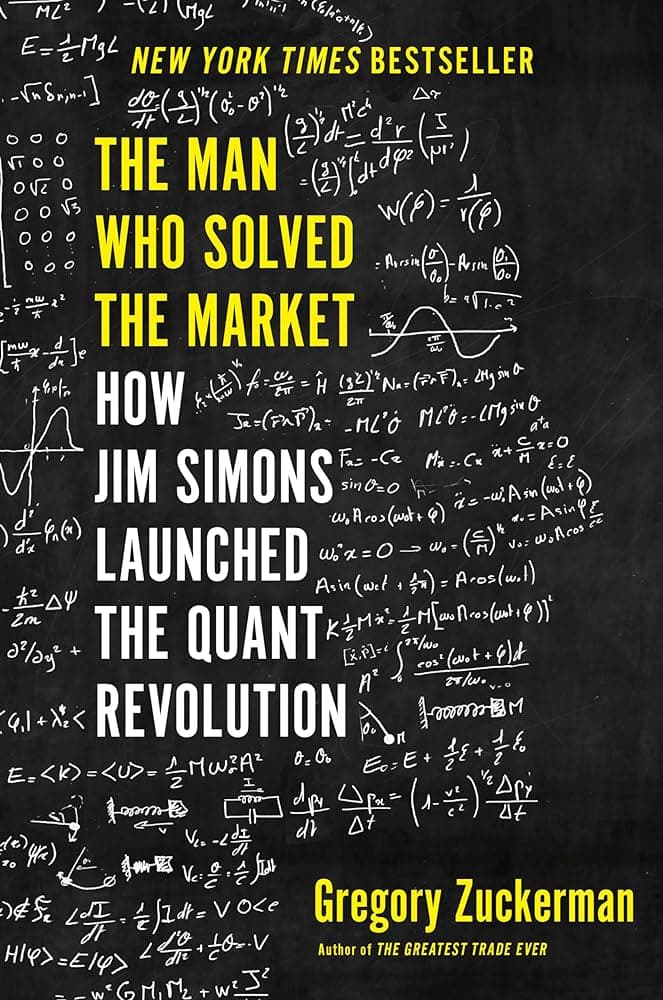
“The Man Who Solved the Market” – Gregory Zuckerman
- Tiểu sử Jim Simons
- Lịch sử Renaissance Technologies
- Insight vào quỹ Medallion
- Xem bài viết chi tiết
Về Quant Trading
“Quantitative Trading” – Ernest P. Chan
- Chiến lược định lượng cơ bản
- Backtesting & validation
- Risk management
“Machine Learning for Algorithmic Trading” – Stefan Jansen
- ML techniques for finance
- Feature engineering
- Model deployment
“Flash Boys” – Michael Lewis
- High-frequency trading
- Market microstructure
- Speed advantage
Tham Gia Bootcamp

Học quant trading từ zero:
👉 Bootcamp Blockchain Mastery – Module Quant Trading
Nội dung:
- Mathematical foundations
- Python for quant finance
- Strategy development
- Backtesting frameworks
- Machine learning for trading
- Live bot deployment
Start Trading
Bitget – Sàn crypto với API mạnh cho quant trading:
- REST & WebSocket API
- Low latency execution
- Trading bots built-in
- Advanced charting
- Copy trading từ top traders
Bài viết được biên soạn bởi Hướng Nghiệp Công Nghệ. Nguồn tham khảo: “The Man Who Solved the Market” – Gregory Zuckerman, Renaissance Technologies public information. Tìm hiểu thêm về algorithmic trading và quant strategies.
Tags: #BlackBox #Renaissance #JimSimons #QuantTrading #HedgeFund #AlgorithmicTrading

Bài viết liên quan